Year of Mud and Worm Intelligence

There is a wonderful editorial in the scientific journal Nature this week entitled “Down to earth” (Nature News and Comment, Nature volume 517 issue 7535, Jan 20, 2015) about dirt, about mud about soil. The Food and Agriculture Organization of the United Nations (FAO) has declared this the International Year of Soils.

Soil, dirt, IS life, at least here on earth.

What is the difference between dirt and soil as positive or negative words? Just where it is relative to where we WANT it to be. When a baby “soils” her diapers, it is because we don’t LIKE to deal with shit that we use the word soil. We wish it would just be somewhere else. When we track dirt into the house, it is dirt, not soil, because we wont use it to grow stuff. Well, those of us who lived for a time with dirt floors know that is kind of arbitrary. It is about aversion and attraction based on… what to you think?

But soil, dirt is life, as basic to our embodied existence here on this planet as the sun and water. And bees. And the only thing of that bunch we are not messing up is the sun; that we are merely wasting but not using more solar energy.

Which brings me to Charles Darwin and worms. One of the first scientists to really appreciate the role of living organisms in shaping the earth, and not just the other way around, his last book written in 1882 was “Vegetable Mould and Earthworms.” Yes, he not only was at the forefront as I have detailed before in animal minds and emotions, but he was also a visionary in ecology and the very thin (one might say essentially non-existent) veil between our earth and life.

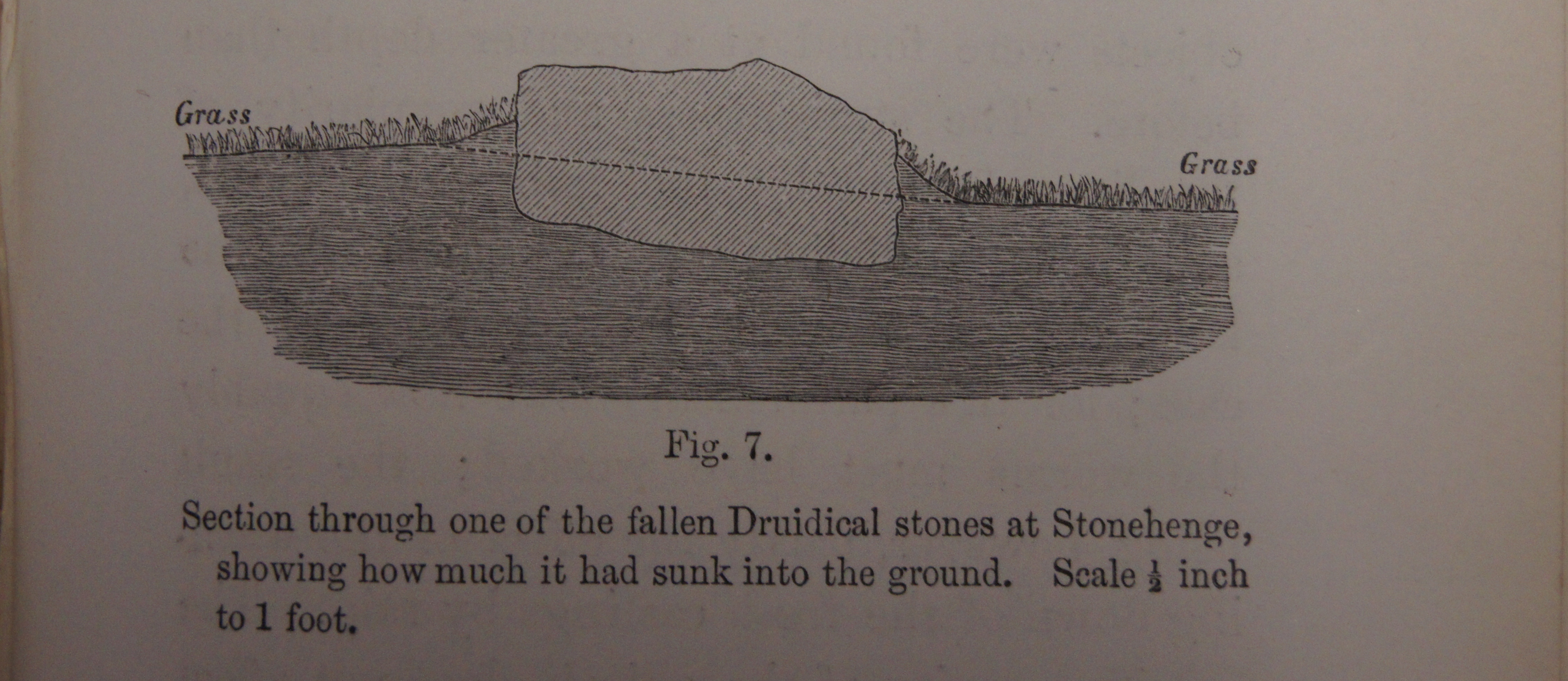
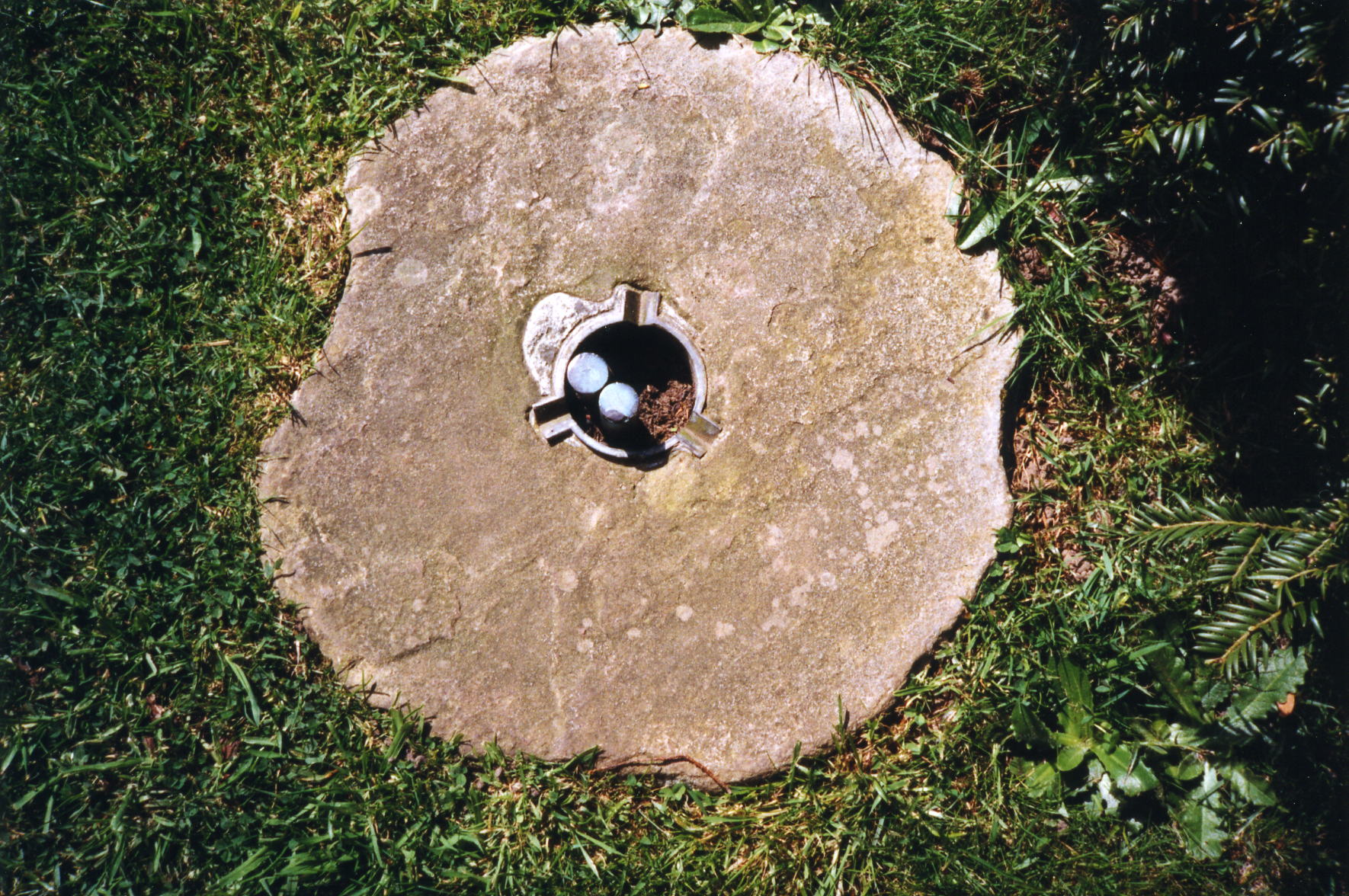
Vegetable mould is the part of the soil that is composed of organic matter derived from, or processed by, living organisms. And worms play a central role. As I mentioned in a previous post, one of the world’s longest experiments is the settling of a round stone in Charles Darwin’s backyard as earthworms eat the soil form under it and shit it out elsewhere. He even documented this process at Stonehenge!

Darwin worm stone

Darwin’s worm experiment

SONY DSC

Effect of earthworms on stones at Stonehenge from the book Vegetable Mould and Earthworms (1888 edition)

But while recognizing the ecologic value of worms and dirt is all well and good, here’s a challenge I suspect most of you will be able to rise to: do you think Charles Darwin thought earthworms are intelligent? Or do you put him in a box of “scientist” who can’t possibly see that they could be sentient beings, who sees all life forms as mechanical automatons.

Well, you know from how I asked it (you did go to school, right?) what the answer is. I quote:

“Judging by their eagerness for certain kinds of food, they must enjoy the pleasure of eating. Their sexual passion is strong enough to overcome for a tie their dread of light. They perhaps have a trace of social feeling, for they are not disturbed by crawling over each other’s bodies, and they sometime lie in contact… they pass the winter either singly or rolled p with others into a ball at the bottom of their burrows Although worms are so remarkably deficient in the several sense-organs, this does not proceed intelligence… we have seen that when their attention is engaged they neglect impressions to which they otherwise attended and attention indicates the presence of a mind of some kind. [comment: some level of free will as Thomas Campbell might suggest?] They are also much more easily excited at certain times than others.” [p 35]

Later in the book Darwin has 32 pages in chapter 2 on “Their Intelligence” where, as a good 19th century naturalist, he collected data on how worms chose what material they used to plug their burrows.

So while many scientists might indeed question whether worms are sentient, WE (you, me and Darwin) won’t, will we? Like Darwin, we recognize sentience when we see it, don’t we? And we are certainly big fans of dirt and worms. Our lives depend on it!


Belief Traps

214

The Diamond Sutra professes that we mistakenly believe in ourselves as persons that are persistent and real entities. We make it up. We want to believe we are this and that and more.

The Lankavatara sutra discusses how we approach reality blinded by  our perceptions and projections, creating rabbits with horns.

A Zen Master said, name the color, classifying it and believing thereby that you know what it “is” in some concrete and enduring manner, and you blind the eye.

As the Enlightenment polymath and genius Laplace is supposed to have said on his death bed, we chase phantoms.

Beliefs.

We want to grasp intellectually, to touch, smell, taste, see, and hear it all. And when we can’t, we fill in the blanks with what we believe should be there, projecting our beliefs, like the way our brains fill in the physiologic/anatomic blind spots in our vision or the details in our peripheral vision that we don’t really see.

We are trapped by our beliefs, and they don’t have to be the clearly wrongheaded absurd beliefs those other people believe that lead to such disasters all of the time, as we can plainly see. Seemingly benign and elegant beliefs can still trap us and become a filter, a distortion, an unconscious bias that keeps us in a fog of delusion, keeping us in a stupor of ignorance.

On top of that, when we have sufficient insight to discover a belief we might be trapped by, a cobbled together way to pretend to ourselves that we know what we are talking about, to explain ourselves and to make our selves more comfortable, allowing us to at least have the illusion that we have some control over things we don’t really understand or have the big picture for, we often simply replace that exposed belief with a more subtle or palatable belief.

We use beliefs as shortcuts, to make our lives easier. That may be a necessary temporizing measure, but it doesn’t work for long. Our beliefs often confer a false security. We are like the turkey that thinks seeing the farmer means feeding time, until of course he is carrying an axe one morning in late November.

This is because beliefs, to the extent that they are beliefs, reflect our state of ignorance, which means our degree of entropy and disorganization, the energy not available for us to use consciously and conscientiously (more on entropy, ignorance and information later), and are at best simply a set of working hypotheses to guide us until we evolve and mature in our actual experience of reality.

Both Buddhism and science (though not all Buddhists or scientists, of course) stress experience (the word “experiment” was derived from the word “experience”), not authority or beliefs. But lacking the requisite experience and maturity, driven by fear and grasping for reassurance, we can’t abide empty files, incomplete knowledge or unclassified experience. They taunt us and remind us of our ignorance, our tentative situation. Of impermanence. Of our limitations in the world of the senses.

IMG00113-20100607-1153

Of course, that is in part why I have thought quantum mechanics might be worth looking at at all for a student of Zen. Whatever interpretation of what quantum mechanics is “really” about that you favor, quantum phenomenon minimally demonstrate that we have to resist trying to jam reality, even experimental reality, into the “how it really is” mentality of the beliefs we hold, the classifications we walk around with in our heads based on our day-to-day experience in the 4-d world of the senses at the level we experience energy transformations.

It won’t fit.

You can jam your experiences into your beliefs and your beliefs into reality, then close the lid, like pushing a spring loaded clown into a Jack in the Box, but eventually the music will stop and pop goes the weasel.

This includes beliefs in materialism (science), Platonism (math), philosophy, post-modernist relativity, religion, political or social ideals, or artistic/poetic ideals like beauty or romantic love, and yes, even Buddhism! To the extent that they are indeed beliefs that are treated as more than mere provisional models to orient you (or say Buddhism as template, as Nyogen likes to say), to the extent that they are concepts, files you need to fit your experiences into, rigid structures that can not expand as you grow and evolve, I suspect that they will sometime or another fail. And then they will cause pain and suffering for yourself and others. Or at least disappointment and disorientation!

I bring this up today because I came across this sentence that I wanted to share in a book called “My Big TOE” by Thomas Campbell:

“Jeez those belief traps are amazing – they can transmute simple ignorance and incompetence into blind stupidity in a flash.”

Been there, done that!

Beliefs: a very, very subtle practice.

138

photos courtesy of Susan Levinson

All Buddhas Throughout Space and Time (and you and me and everything else)

This is how Lancaster and Blundell begin their book “Quantum Field Theory for the Gifted Amateur” ( note: by “gifted amateur” they mean someone who knows something of the math of basic quantum mechanics, relativity theory and Fourier transforms, but is not a professional physicist!):

“Every particle and every wave in the Universe is simply an excitation of a quantum field that is defined over all space and time.”

I remember the first time I heard in our service at the Zen center the part of a chant that goes: “all Buddhas throughout space and time…”

Pretty straightforward, and I suppose not exactly quantum field theory, but I was hooked.

Slide3

Quantum Peak Again

There is another famous experiment that I would like to talk you through. I will try with lots of schematic drawings. The pay off is that it is another look at how the quantum world is beyond our day-to-day experience and how our basic notions are projections. For now, that is plenty! We can go deeper later.

We are going to look at what happens when a light goes through an interferometer.

Lets look at the basic set up, a “big picture” look.It is all there, but we will have to go over it step by step. First, what is in the diagram?.

Slide02


There is a light source, here the green lamp in the lower left corner of the diagram.

The yellow arrows indicate the path the light takes.

There are four mirrors, one at each corner, all indicated by diagonal lines.

Two mirrors, one at the upper left corner and the other at the lower right corner, are indicated by a single blue line. They are full-silvered mirrors and they reflect all the light that comes to them.

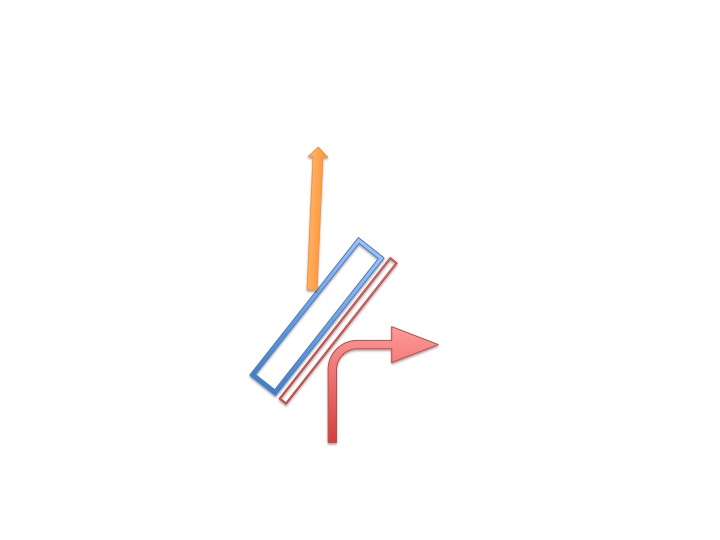
Two other mirrors, one at the lower left corner and the other at the upper right corner, are half-silvered mirrors. These reflect half of the light that comes to them, and let half of the light through. A very important point is that the half-silvered mirrors have a front and a back. The back, here indicated by a red line, also reflects half the light and lets half the light through, but there is a change in the reflected light when reflected off the back ( red) side of the half-silvered mirror. The “phase” of the light is shifted. We will get back to that in a bit; it makes all the difference.

The black trapezoid objects in the upper right par of the diagram are light detectors. That is, they will register the light that gets to them (and their color will turn from black to yellow here in these diagrams).

This next diagram shows another overview showing what will happen. We send light through the interferometer and only the top light detector registers light. Why is that? What happened to the light going toward the lower right detector?

Slide03


Lets follow the light,

Slide04

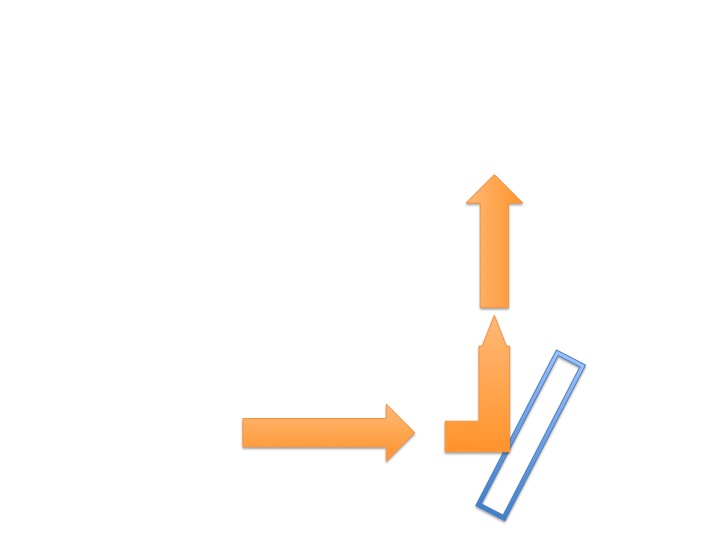
Here we see the light that came from our lamp at the lower left in our first “big picture” diagram. This light first interacts with the lower left half-silvered mirror. Half of the light is reflected, and because of the mirror’s angle the reflected light is sent up in this diagram. The other half of the light goes straight through along the bottom left to right. This is why there is a half-silvered mirror here at the beginning of our interferometer device, to split the light into two pants, an upper and lower path.


Slide05

The half of the light that was reflected straight up along the upper path at the first mirror now reaches the upper left full-silvered mirror and all of that light is reflected, now going along the top from left to right.

Slide07

The half of the light going left to right on the lower path that went through the first half-silvered mirror next reaches the lower right full-silvered mirror and is reflected up along the right side of our interferometer.

Slide04


The light in the upper path going from left to right reaches the upper right corner half-silvered mirror. This light from the upper path is again split at the half-silvered mirror at the upper right just like the light was at the first half-silvered mirror at the lower left corner of the interferometer. At this last mirror once again half of the upper path light goes through unchanged, and half is reflected up to the top light detector.


Slide08

Now here is where it gets a bit tricky. The light from the lower path next reaches this last half-silvered mirror in the upper right corner of the interferometer. But this time it interacts with the back of the half-silvered mirror! This light from the lower path is also split at the half-silvered mirror. The half of the lower path light that goes straight through the half-silvered mirror continues up to the upper detector unchanged. That light transmitted from the lower path gets to the upper detector at the same time as the light from the upper path that was reflected up to the detector, so the light reflected from the upper path and the light that goes through from the bottom path combine and the upper detector registers the light.

Slide09


BUT the light that was reflected off of the BACK of the upper right half-silvered mirror from the lower path is now shifted 180 degrees out of phase by the back of the half silvered mirror! This means the peaks of this light, the “out of phase” light reflected off of the back of the half-silvered mirror, now in red in the diagram (but don’t get confused, that color change is just to make it easy to follow; the light doesn’t change wavelength or color) lines up with the troughs of the light that went through from the upper pathway.

Slide10

So the two light waves, the wave of light that went through the last mirror from the upper path and the wave of light reflected form the back of the mirror from the lower path  “cancel” each other out. They completely “interfere” with each other (negative interference in the jargon). Hence the name of the device: interferometer!

The peaks, like we have seen in previous posts and in the diagram to the right here, we can think of as +1, the troughs as -1. So you can see how the +1 peak lines up with the -1 trough, and that kind of alignment of the same + with – holds true throughout the whole wave. So the +’s combine exactly with the -‘s and cancel each other out (+1 and -1 =0).

Slide11

So NO light gets to the lower right detector, which remains black in our diagram.

When only the upper detector detects light, the lower right detector detects nothing, we know that both paths are open and the light went through both the upper and lower path.

Now for a really amazing result: if we send one photon at a time through, once again only the upper detector registers light! The indivisible, basic particle, the photon say (but other particles and even small molecules have been shown to do this), the discrete energy carrier of electromagnetic waves, is in both pathways. But it can’t be, a photon, a particle, is a most basic thing, it is not divisible, of course.Right?

Well, yes, but no. This situation where the photon interferes with itself when both paths are open is called “superposition.” It almost seems as if the photon is “in” the two paths at once in superposition. This is a mathematical idea, of course. Superposition is a word for a phenomenon that can be mathematically described but has no four-dimensional meaning in any sense we can picture or comprehend based on our day-to-day experience and our monkey brain.

The particle is, in effect, going through all possibilities of all of the paths, every one however unlikely (in this “simple” case both paths are equally likely). Though of course that is impossible in ordinary time and space.

Now, if you block a pathway, then both detectors detect light!  If  you send a beam of light through just one path (either upper or lower;in the diagram below it is the upper path) both detectors register light. If you send one photon at a time through only one path of the interferometer then only one of the two detectors will register each photon that goes through, but over many runs with single photons half the time the upper detector will register the photon, half the time the detector on the right will register the photon!

Slide12

To see what is happening, in this diagram the upper pathway is open, the lower blocked. At the upper right half-silvered mirror half of  the light (or half of the photons over different run when one photon at a time is sent  into the interferometer) goes through the mirror to the detector on the right, half at the light (or half the photons over different runs) is reflected up to the upper detector.

The situation is the same if the upper pathway is blocked. The light reflecting off the back of the upper right half-silvered mirror is indeed phase shifted as before, but there is no other light wave from the upper path going through the half-silvered mirror to “interfere” with the out of phase light (the detector doesn’t care about the phase), so there is no “negative interference,” No two waves to cancel each other out!

So if both detectors light up when a beam of light is sent through, or over many runs with individual photons, you know that only one pathway is open!

This shows that indeed photons can act as discrete particles that can be detected one at a time. As before with the double slit experiment though we have to ask, how do they “know” to go half the time to one or the other mirror if they are separated in space and time?

Here is the kicker. If you don’t block either pathway, but set up some sort of detector that will tell you which path the photon is on, even if you can show it doesn’t mess with the photon in any way you can tell, it is just as if the other pathway is blocked. The superposition disappears! Both detectors will register light (again, when sending only a photon through at a time they won’t both detect the photon at the same time, one or another will do so, but over many runs it will be half and half again!).

Lets stop here. This is one of the big deals in quantum mechanics. Why does “knowing,” that is detecting the photon on one path or another make a difference? What does knowing or detecting mean? And didn’t we already show the photon is in this weird superposition as if it is in both paths at once?

I told you not to get hung up on how you are picturing this. It won’t work.


Special thanks to Prof. Benjamin Schumacher whose Great Courses lectures on quantum mechanics are very good and who presented this version of the interferometer.

Energy, Sensation, Perception

 Unknown

Sensation and perception are how we seem to experience the world. Practitioners of Buddhism and science have given a lot of attention to how we do that and what it means.

From the scientific viewpoint, sensation occurs when a specialized organ interacts with the form of energy it evolved to interact with. These specialized organs are the sensory receptors in the eye, ear, nose, skin, or tongue, for example, though animals have a large array of receptors, like infrared receptors in pit vipers or sonar in bats.

And in an inspired insight I particularly admire, in Buddhism the brain is also a sense organ, one that “perceives” both sensory inputs from other sense organs but also you might consider thoughts a sensory input. Continue reading

Behind the Curtain; A First Peek into Quantum Weirdness


242


Quantum mechanics grabs the attention of so many people for some good reasons.

Quantum mechanics deals in the atomic and subatomic realms. In the reductive scientific program it is about as small and basic as you can go based on actual experiments.

The results of these studies have led to highly reproducible observations and measurements.

These findings have led to technologic breakthroughs.

 And because quantum mechanics is counterintuitive, bizarre and no matter how hard you try to picture it, model it in your head, think it through, intellectualize, fit in into your daily four-dimensional experience of reality, you will fail, like thousand upon thousands of great minds have failed for a hundred years.

Let me start with an example. I will give others in future posts. Continue reading

Defining Energy

254

The palpable universe and how we perceive it and know about it is all about transformation of energy (see also the post “Change and Suffering, Phantoms and Dreams”).

Energy patterns upon energy patterns.

We know energy is fundamental. Besides our intuition and use of the word very freely in common parlance, everyone knows that Einstein informed us that things are convertible to energy and energy to things:

E=Mc2

E= energy, M= mass, c= the speed of light. Since c (the speed of light) squared is a constant, just a number that doesn’t change but makes the units work out:

Energy IS mass (stuff/things). Mass IS energy. Continue reading

Why Zen and Not a Modern Mindfulness Practice for Me?

SONY DSC

Print by Claudia Hosso Politi Sensei (teacher at the Black Scorpion Zen Center in Mexico)


If my goal was only to be a little calmer and improve my day-to-day life, a modern mindfulness approach would be easier than Zen practice. There is a mindfulness center at UCLA where I work. It looks really good judging from the website and a couple of brief conversations I have had with the staff there, and would be much more convenient than driving across town to a dicey neighborhood to the Hazy Moon Zen center. Mindfulness practices are certainly less demanding than a sesshin (a very formal and intense meditation retreat, usually lasting 3-10 days). Maybe it would even be a good career move; I could be the mindfulness eye doc without this Zen baggage! Continue reading

Change and Phantoms, Suffering and Dreams

SONY DSC

Is the river the same river one moment to the next?

Change is the basis for everything that is. In Buddhism this is referred to as “impermanence.”  In Sanskrit the word is anitya (anicca in Pali, wuchang in Chinese, mujo in Japanese).

Anything that has component parts, that came together as aggregates in time and space as a result of some set of causes or conditions, presumably following the laws of science, is impermanent.

Nothing lasts forever. It all comes apart.

Causes and conditions will change, in part due to what they caused. Once something has been caused, it has changed the universe. Feedback loops; wheels within wheels. And when the causes and conditions change, all that they caused and all that is dependent on the conditions change as well.

Impermanence is considered one of the “three marks of existence” in Buddhism, the other two being suffering (dukha) and non-self (anatman). The insight that change is fundamental and its relationship to suffering is at the heart of the story of how a sheltered prince became the Buddha.

The Buddha is not an Asian God. Buddha means one who is awake. You might say Buddha is one who does not make chimeras or pursue phantoms as a way to cope with impermanence.

Gautama of the Shakya clan lived in what is now Northern India and Nepal about 2,500 years ago. Tradition has it that when he was born it was foretold that he would be either a great king or great spiritual leader. His father, the king, had the opinion that his son becoming a great king was the preferable outcome. The prince was coddled and protected from life’s harsh realities, and that worked for a while to distract him, keeping Gautama focused on having a good time and being a prince destined to rule. This changed when Gautama was traveling with a servant, kind of slumming it in town outside the palace gates. There he saw a sick person, an old person, and a corpse. Gautama was shaken up much like Gilgamesh was at the death of his friend.

That will happen to me, he asked. Yes, his servant, also a friend, answered, it will happen to everybody. Nobody, not even a king, can stop change.

The prince then saw a yogi, a spiritual seeker, who seemed to be at peace. How is it possible that the yogi was not totally crazed by all of this?

Great yogis can achieve wisdom and not be threatened by change, his companion replied. They can transcend the limitations of life and death.

What was a prince to do? Like Gilgamesh he set off on a quest, but for a different kind of immortality. It was not a permanent body or personality he sought, but the timelessness of enlightenment.

Stealing away at night, Gautama cut his long perfumed hair and gave away his princely clothes. For six years he took up yogic practices. He was very good at it, and his teachers wanted him to become a teacher and carry on their traditions, but while he had achieved great accomplishments in meditation, he knew that he wasn’t enlightened. He had not come to terms with change, with death. He was driven to go deeper, and took up such severe yogic austerities that he almost died and had to be revived by a drink of milk given to him by a young woman. He used his new energy to meditate and became enlightened.

His fellow yogis thought he had sold out by drinking that milk, so at first they wanted no part of him. But then they saw he was transformed. They asked him to teach them about what he had found and he laid out the Four Truths.

The first truth is the truth of suffering. At best, you can find bliss and have wonderful, ecstatic experiences, achieving prolonged periods of happiness. You can live that life of Gilgamesh, enjoying the things of your world. It isn’t all that bad for most of us most of the time. But somewhere along the line, no matter how hard you try, no matter how sincere and good and kind you are, there will be suffering. It may be no more than a small disappointment, some slight frustration, existential ennui, maybe just boredom, or it could be horrible and devastating pain, but suffering is inevitable. Look at everything you want to have. You either can’t get it, or if you can, you will lose it all someday, when you die if not before. Look at everybody you love. Either you will die first or those you love will die first. Which is better?

The second truth is the cause of suffering. Mistaking what is impermanent as being permanent is one of the traditional Buddhist “inverted views” (Sanskrit viparayasa, Pali vipallasa, Chinese diandao, Japanese tendo) that leads to suffering. The Chinese word literally means upside down; it is a matter of upside down thinking.

We only see our separate lives, our limitations and the world of change, beginnings and endings, birth and death, so we live in fear. We are afraid of change; it means loss. The loss of what we love, what we possess, the loss of our bodies and identities in the long run. Our lives, who and what we seem to be, are a lesson in impermanence. Everything changes by the second. Actually everything changes in incredibly small fractions of a second. So we attach to the bits and pieces of our lives, making up stories that help us stitch together chimeras, projections of our desire to hold on, endowing them in our minds with substance and continuity where there is really vast and uncompromising change. We suffer because we cling to the illusion that if we can stop the flow, stop evolving, just get our lives where we want them to be, we can get it right, keep things static, and live happily ever after.

That won’t happen.

The third truth is that there is a way out of suffering. And the fourth Truth is that way, the practice. It comes down to living in awareness, awake. Surf the wave of change, don’t fight it, don’t grasp at what can’t be grasped, trying to hold on to what won’t be held. Evolve. Live life based on love and compassion, not fears and desires and hidden agendas.

When I was in medical school I had some appreciation of this essential role of change in Buddhist terms, but it would also turn out to be the first means by which science entered my life in a deep way. Despite my earlier harsh judgments about science and progress, I surprised myself by enjoying my pre-med and medical school science courses. I applied myself, worked hard, and graduated at the top of my medical school class. Nonetheless, I was goal oriented, learning what I was told was required to be good doctor; I didn’t give much thought to science beyond the curriculum until I had a conversation with my cousin.

Warren is my first cousin, but he is older than I am and I didn’t really get to know him until I was in medical school. Warren is a medical doctor who didn’t practice clinical medicine after a stint in the Navy as a flight surgeon, but instead got a PhD and went into research. He was on a research team whose senior members won a Nobel Prize for their research on viruses, genes and cancer in the 1970s. His passion is teaching; Warren has taught microbiology to medical students in San Francisco and around the country for over 40 years and has been given many awards and accolades as a teacher.

Warren told me that evolution was critical to understanding anything about modern biology, and so to understanding life. Of course I understood evolution was important with implications, for example, for such practical issues like antibiotic resistance or the development of the immune system. I hadn’t thought about it as deeply as Warren was inviting me to before. Warren was very patient with me and he introduced me to a scientific view of the world.

I saw that evolution embraces a vision of change that is exquisitely fair and just. Evolution is fair because it is not something that judges at all. It is not about divine punishments for our sins or rewards for following a prescribed series of rituals, believing the right dogmas and thinking the right thoughts. Evolution is like the statue of justice with a blindfold. You can’t charm it, you can’t suck up to it, and you can’t bribe it or con it. Evolution is about what works, meaning in this context what makes more life. Change will happen, and when it does, and it works, that is what you get more of because that is what working means, surviving to have more babies. A bit of a tautology really, simple but effective.

Biologic evolution is not about creatures realizing some standard of perfection. It is not about nature striving to achieve the final perfect organism. It is a freeform dance, not a march toward some Platonic ideal, the perfect horse or the perfect beetle. It is life oozing and changing wherever it can, however it can, whenever it can.

It isn’t about us as humans, we are not the ultimate goal. Chimpanzees and bonobos are not small, powerful, dumb people. They are not losers who missed out in the race to be humans. From the biologic point of view we are being very arrogant when we think like that. Personally, in a world with no humans to destroy habitats or hunt apes down for meat, I think I’d rather be a bonobo. The females run their societies and they say hello with oral sex. That can’t be all bad.

Chimpanzees and bonobos are not our ancestors, but are our forest dwelling cousins. We all evolved from some ape that lived over 6 million years ago. A river separated chimp and bonobo ancestors almost two million years ago.  The genetics and fossils are compelling. But just look at chimps and Bonobos and you don’t even really need molecular biology or ancient stone fossilized skulls. It’s that obvious.

File0504

This image is from Huxley’s “Evidence of Man’s Place in Nature” (1863). It has often been changed to show the evolutionary  progression from sea creatures  to land  animals, then to us walking upright, but this original is about comparative anatomy. There weren’t  many fossils or any genomes (and no real idea about genetics at all, for that matter) to go by back then, but the brilliant Darwin and Huxley grasped the relationship between us and our closest cousins, and the evolutionary implications of this relationship.

The slug on the lawn has also evolved for exactly as long as we have from the first living cell to the day we cross paths after a good rain. That slug is a distant cousin, and is clearly is a success story because there it is, slugging along living its slug life after 4 billion years of evolution. Slugs evolved into slugs long before we evolved into intellectual giants, and they may outlast us. Our big brains dedicated to the service of fear and greed may turn out to be a failed evolutionary experiment rather than the crown of creation!

There was even more to this biologic view of the world for me, above and beyond this value neutral, harsh but fair view of nature. Evolution explains so much about who and what we are in a way many of our religious traditions do not. Lets take sex as an example. Gonads and sexual desires are easy to explain from the point of view of evolution. They create diversity and keep life going. It isn’t a question of shame and blame, of a God who gives us raging hormones but judges and damns us for eternity if we use them in other than the acceptable fashion, that is, with no imagination and only to procreate. Sexuality is not intelligently designed to be a test of our will power, our ability to suppress desire, and success in life is not a matter of achieving some arbitrary state of purity. Sexuality is a question of what worked starting half a billion years ago to allow for a bit of variety in our offspring by mixing mom’s and dad’s genes and to drive us to make more of us, starting way back, before we were even fish.

It is up to us to deal with our sexuality in ways that don’t cause suffering for us as creatures that evolved for sophisticated social interactions and a need for loyalty in order to cooperate in raising our helpless slow-growing offspring. It’s a tall order in and of itself, and remains one of our greatest challenges, but it isn’t about being judged by some external standard of good and bad.

There was also the sublime vision of all life as one life in the scientific view of evolution. As Darwin wrote at the end of “The Origin of Species”:

“…there is a grandeur in this view of life, with its several powers, having been originally breathed into a few forms or onto one; and that, whilst this planet has gone on cycling on according to the fixed law of gravity, from so simple a beginning endless forms most beautiful and most wonderful have been, and are being, evolved.”

To say “we are all one” may be new-age spiritual, but it is also an unadulterated scientific fact. There are the vast and elegant webs within webs that we are embedded in, that we all share. The laws of physics, the state of the universe, the solar system, the earth and all life together create what we are as living breathing, eating and secreting, reproducing organisms. There is the complex ecology of the earth we depend on and the ecology inside our bodies; we have 10 times more bacterial cells than human cells in our bodies, and they are necessary for us to survive. We can’t live outside of these external and internal ecologies, these wheels within wheels.

But it is even much more fundamental than that. All life on Earth is truly one living organism. Every cell is the same cell. Savor that. Every cell that ever was or is now, is the same cell morphing over time. No creature, large or small, makes a single cell from scratch. Every cell came from another cell.

We are each of us derived from a single cell: our mother’s ovum. The ovum is a big juicy cell that is released from the ovary in the middle of the woman’s monthly cycle between menses, whose job is to be fertilized by sperm. When the ovum is fertilized it triggers a cascade of events. The ovum changes and, then starts dividing, and chemical signals released from the altered ovum and then from the daughter cells initiates the development of differences between those cells. If it didn’t we’d just be a ball of cells, and not a very big ball or one that would last very long. This ball of cells grabs onto the inner uterine wall, sucking life from the mother’s tissues. This starts a cascade of signals and cellular interactions that leads to other cascades, an exquisitely timed series that keeps going throughout life. We ARE our mother’s ovum writ large. This is not a metaphor. Sure dad sprinkled a bit of genetic diversity into the cell, but that wasn’t really necessary. We need that first cell; we can’t make ourselves without a starter, like sourdough bread. In fact, there are some animals that can easily do without dad. Mom’s ova just start dividing and presto: babies happen. Look it up if you want to impress your friends, it’s called parthenogenesis.

Just as every one of our cells came from our mother’s ovum, with its cell membranes and other cell parts making up our first cell, that ovum came from her mother’s ovum and cell membranes and other cell parts, on back, mother to mother, to before there were ova, to way before we slithered out of the sea. And even further back, to before there were mothers and daughters, to our single cell ancestors and then back again to the first cell or group of proto-cells, whatever we were in deep, deep times past. We’re talking 4 billion years past.  All creatures alive today are at the base of an inverted mountain whose peak is that first replicating, living cell, in total continuity, with no break in the lineage. It is the same cell membrane for four billion years, just expanded and replenished with new atoms. It is the same DNA, also constantly replenished, but with just a bit of variation here and there, a little wiggle in the genes. When the wiggle works to make the organism better able to survive and multiply, then it persists. This is evolution.

You are at the same time the tip of a mountain of all living things. All life throughout history led to you. You have two parents, four grandparents, eight great-grandparents, sixteen great great-grandparents, on and on, a geometric progression going back through time to before there were parents and grandparents. Doing the math (trust me, or do it yourself: 2 to the power of how many generations you want to look back times the average time per generation) it doesn’t take long before you have more ancestors than people who ever lived. About a thousand years should do it. Of course, that is a bit misleading, as it assumes no duplications, cousins marrying cousins, or dead ends, so you may have to go back over a hundred thousand years to find a common ancestor if you are looking at a specific gene. But for the most part, you don’t have to go back very far at all. Each one of us is the great, great … great, great-grandchild of slaves and sovereigns, saints and sinners, sages and simpletons.

Even if you have to go back as far as one or two hundred thousand years to find a human ancestor that you share with every person alive today, that is not all that long ago in the history of life or by geologic standards of time.

In fact, geologic time is the time frame of life. Life is geological. Not only because the drifting and shape-shifting continents crash into each other or tear each other apart and meteors colliding with earth change the environment, sometimes gradually and sometimes catastrophically fast, setting the scene for mass extinctions and subsequent spurts of evolution.

And not only because the elements and the flows of fluids and gases we rely on to make and maintain our bodies are all part of the geologic system, earth and atmosphere as Gaia, herself a living breathing, weeping, flowing, secreting, belching, entity. It is because we, and all living things, ARE the earth, little moving clumps of earth stuff, mini-mountains that wiggle and squirm and slither.  Spontaneous generation. Life came from non-life in the view of evolutionary science, chemistry and physics. There is no other valid materialistic scientific viewpoint.

Where can we draw an unimpeachable dividing line between life and non-life, between us and geology, geology and the universe?

We can define life as some subset of things in the universe.  We are fond of dividing, classifying and reifying, so that whatever we are thinking about is easier to grasp and fit into our limited notions of how it should and could be. Scientists who search for life on other planets have to have something to work with, so they think and write about how to define life. We can decide life is, say, those things that replicate. Are computer programs alive? What about a code that replicates itself, a computer virus or artificial computer life? Perhaps in a sense they are alive. What about defining life as things that have carbon based DNA? That leaves out the computer program, but why should we set that limit? Maybe there are such life forms on other planets or their moons that use different molecules to encode the information life needs to function.

What if we invent robots that are carbon based, can make more of themselves, and even use DNA for information storage? In these days of nanotechnology and 3-D printers and the first glimmering of quantum computation, it isn’t totally out of the question that we could achieve this in the near future.

In fact scientists do have a hard time defining life, and there is no universally accepted definition. A recent book, “What is Life,” references 40 different definitions.  The author’s starting point is the observation that life emerges from non-life. That seems obvious, but it is a critical premise. How are we, how can we be, in any way separate, outside, different, from the universe itself?

Some religious idealists don’t like the idea of spontaneous generation because it seems to fly in the face of a unique creation of life by a God outside of creation. Spontaneous generation, as conceived of before Pasteur, proved it wrong, was exemplified by the “spontaneous” appearance of maggots on rotting meat. The maggots were really hatched from flies’ eggs that were too small to be seen on the meat. That wasn’t considered proven until Pasteur in the late 19th century performed an experiment in which glass flasks with long elegantly curved necks were filled with a nutrient broth and found to remain sterile even when the end of the elegantly curved flasks’ necks were open to the air. You can still see the flasks in Paris at the Pasteur Institute. We might think Pasteur was challenging the delusions of foolish superstitious people who believed in the supernatural emergence of flies on meat, but that wasn’t what he was up to at all. Some biologists at the time thought that may be how life and evolution works, with new primitive forms being generated again and again as earlier ones evolved and became more complex. Pasteur was a devout Catholic and was not fond of the idea of spontaneous generation that was taken to imply that God didn’t have an original active role in a one time only, biblically mandated unique creation.
SONY DSC

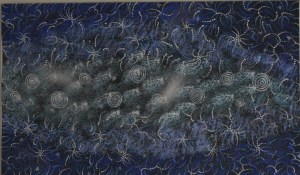
“Emu Story in the Milky Way” by Gavan Urandali Flick of Kamilaroi (Australia) in which Emu becomes the Pleiades (the seven sisters) and Bundar the kangaroo sings to the wind to create changes to the waters and the dingo becomes the star Orion, howling to create storms .

Yet certainly every scientist believes ultimately in spontaneous generation, that life, the first cells, came from atoms of metals, minerals and water found in the clay of the early earth, in its oceans and in the gases of its atmosphere.

What else could we be but the product of those earth atoms, smaller atoms that were formed when the universe cooled enough for subatomic particles to congeal into atoms almost 14 billion years ago, and larger atoms forged later in supernovae, the massive explosions of large dying stars?

So while biologic time is geologic time, it is also cosmic time. And before 14 billion years ago, these subatomic particles came from the energy resulting from the birth of our universe that came from the infinite energy that …

And so where are we? What is this really all about? What is more fundamental even than energy?

I suggest we have come to the dreams stuff is made of, the source of phantoms, the fire that gives life to the equations, to what is not limited by “is” and “is not,” or to “changing” and “permanent.”  We come to Mind.

Photos courtesy of Susan Levinson
Continue reading