It’s All About Mind at Play; That Is, It’s All About You

143

From the book “ A Beautiful Question” by Nobel Prize winner for physics Frank Wiczek:

“The human mind is our ultimate sense organ.” p. 159

This is true. Buddhism has had the mind as the sixth sense as a given truth for a couple of thousand years plus. Note Wiczek wrote “our” and that’s why “human brain.” It would also be true of any sentient being, brain or no brain.

This is also consistent with Biocentrism, as described in the two books by Bob Lanza and Bob Berman, “Biocentrism” and “Beyond Biocentrism.”

There is no separation, no out there. Sentience is all that exists. Beyond sentience, how can we talk about existence? What right, what warrant, as the logicians say, would we have for postulating something or nothing outside of sentience?

All our sense organs do is register changes in energy, but that is meaningless without sentience. In Lanza and Berman’s most recent book “Beyond Biocentrism” Berman writes about how it blew his mind and he had an enlightenment experience just contemplating that the whole universe he experiences is only what is in his head. This occurred when he was studying for an undergraduate biology course!

Savor that. He went satori reading a college level science textbook, usually thought to be the most intellectual, materialistic, uninspiring, boring thing anyone can read! Go figure! This is a valuable lesson: don’t limit your universe with your preconceptions.

Of course, that’s exactly what we do!

And how is that consistent with ‘no out there, no separation’? A couple of analogies or thought experiments might help:

Cut off one of your fingers (do it under local anesthesia, don’t be cruel). Keep it alive in some nutrient broth. You may experience phantom sensations, still experiencing that finger as being at the end of your hand. Like you did before you cut it off. Those feelings are all in your brain; the finger’s in a vat in another room. The finger was always an experience in your head. And later burn the finger. Did you feel it burn? That finger was you; it is you…right? Maybe not when your head doesn’t feel the pain? The finger has nerves that were kept alive, and they are certainly firing away, but how can we speak of pain as it burns in another room, separated from your brain? All we can speak of is the energy from the fire causing electric field changes in a tissue due to ion fluxes.

A current in the ocean appears to be separate from the water around it. It has different energy, that is, different momentum (it moves in a different direction and speed and may have different density from the water around it due to temperature differences i.e. a different mass/volume of space. Momentum is mass times velocity; velocity is speed with direction. Momentum, along with potential energy, is how we describe the total energy of a system in mechanics). The local differences in momentum are why it is experienced as a current. But it’s all water. It’s all one ocean, no matter how we divide it up with different names based on our limited experience, our local sampling of conditions, and our perceived needs in our subjective time and space. The energy of the current will dissipate and equalize with the rest of the ocean unless energy is pumped in by the sun and mediated by temperature changes, kinetic energy from storms, etc. Either way, nothing is lost, nothing is gained. Just energy transformations in One Ocean.

These analogies sound dualistic, so this and that, here and there. All those fingers, brains, oceans and currents. But that’s just the limited nature of analogies and language. What does Buddhism say about this? We chant “The Identity of the Relative and Absolute,” a Zen poem by Sekito Kisen from the Song dynasty about a thousand years ago that I have written about on this website before. He wrote: “the relative and absolute fit together like a box and its lid.” The ancient Zen master grasped this apparent scientific conundrum of what seems like duality in what must be non-duality (must be; how can there be something else? Again, by what warrant do we come up with such a silly concept as dualism?), and wrote a poem that holds up a millennium later. Gotta love it.

There is symmetry in the identity of the relative and absolute. The key word is identity; that is what a symmetry is. Change that keeps an identity. A circle is rotated; it changes but is still identically the same circle. It is symmetric to rotation.

As I have written about here before, symmetry is at the core of the mathematical formulations of modern physics. Wiczek writes about symmetry, describing it on p. 166 of his book as “Change Without Change.” He goes on to write that this is “a strange inhuman mantra for the soul of creation. Yet its very unworldliness presents an opportunity: we can expand our imaginative vision by making its wisdom our own.”

But while I agree about its wisdom, I think it is actually very human and not really unworldly, except in our limited day-to-day quotidian experience of our world; it’s just not limited by our humanity, by our “worldly” experiences in the illusion of time and space.

Change without Change. The identity of relative and absolute. That’s as hard-core, old school Buddhism as it gets.

Remember:

Science’s best model (quantum physics) says it’s all energy fields, throughout space and time. But as Lanza and Berman point out in their books on Biocentrism, time and space are dicey concepts. We invent time and space post hoc and ad hoc, to try to bring it all down to size, to grasp it all for what seem in our delusion to be ‘practical purposes,’ to fit our conditioned ideas of reality, our beliefs. Yet we know that relativity says time and space are part and parcel of each other, without independent foundation, at best fluid and relational and elastic, and quantum mechanics says time and space have absolutely no relevance to such basic observations as entanglement and two slit experiments, that reflect the behavior of particle or sets of particles, the most basic of basic entities science can grasp, and by extension, all that is.

Or as the Zen master Dogen wrote almost 800 years ago: Being-Time. Time as our lives. Time is Being, Time is sentience, time is Mind. Space is just the same.

254

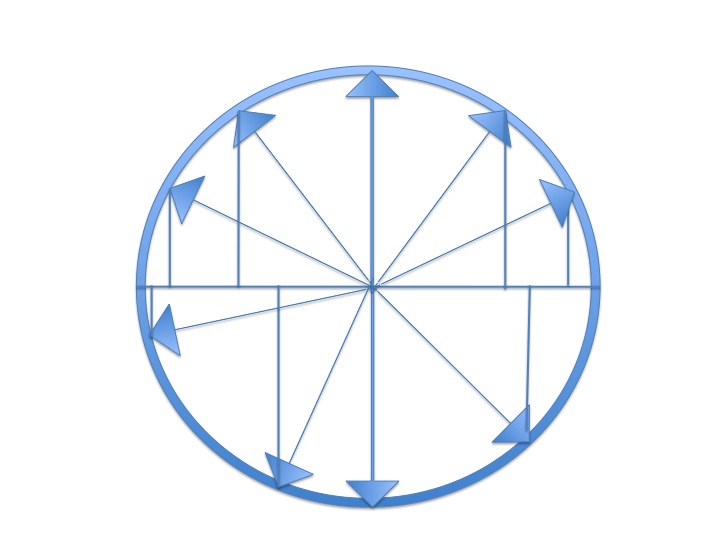
So we have quantum fields without beginning or end, bottomless and topless, because there is no “where” and “when” until we chose to define it. Fields are described by magnitude and direction wherever you look. A particle is a concentration of the energy of that field, a local manifestation, in the sentient perception of space and time.

That’s all there is folks. In quantum mechanics there is no difference between here and there, other than how energy manifests as field or particle when perceived (measured, which is perception), then transforming itself in response. Like Indra’s net of the Avatamsaka sutra, where every jewel instantly reflects the light of every other jewel, which then reflects the light of every other jewel, which then…

And in all this, energy is conserved. Energy is symmetric. Nothing ever added or lost, just self-transformed. Science only understands energy by its perceived transformations. Can’t define or measure it directly. Can’t say where it came from or where it is going (no beginning no end).

As written in the Heart Sutra, form is emptiness and emptiness is form. Fields (undefined, without limit, without substance, without inherent separate reality) are particles, particles are fields. Mind is stuff, stuff is Mind. Relative and absolute are an identity.

Symmetry.

Or as our ancestors said, as our Zen teachers who know what they are talking about teach, and as Lanza and Berman in their Biocentrism details, it’s all Mind, Consciousness. And keep in mind, mind is Mind, consciousness is Consciousness. Your mind, my mind, our mind, all is relative/local/particle (if you will) manifestations of absolute Mind. Your mind and Buddha Mind, you and the Buddha Field. Like particle and field, or particle and wave if you prefer, as identical as the identity of relative and absolute of ancient Sekito’s poem. Don’t get hung up thinking the words that pop into your head, the concepts you are conditioned to believe, are the limit of your mind.

Slide3

Red Pine writes in his translation of the Diamond Sutra that the Tang dynasty Zen master Huang Po said: “Buddha and beings share the same identical mind.”

Mind is Buddha, the ancients said. OK, they also said Buddha is a turd. Or the cypress tree outside. And they meant it. Literally.

Nyogen Roshi likes to remind us that the Buddhist sutras, the reports of the saying of the Buddha, are about us, our lives. Lanza and Berman, in their books on Biocentrism, say the same thing. It is you. Always was, always will be, to whatever extent we can talk about always. In all ways.

As the late Stephen Gaskin titled one of his books: it is all “Mind at Play.”


SONY DSC


Self Liberating

SONY DSC

800 years or so ago Dogen said something to the effect that no thought requires a second thought (I paraphrase).

In a talk recently Nyogen Roshi said something that really helped me out of a place where I was stuck thinking about things I had screwed up. I mean things going back 50 years in some cases. Quite a litany when you reach into your bag of tricks that far.

He said:

All thoughts are self liberating.

Deep Truths

In his new book “A Beautiful Question” Nobel prize winning physicist Frank Wilczek writes that Niels Bohr, one of  the fathers of quantum mechanics, said that you can recognize a deep truth by the feature that its opposite is also a deep truth.

Makes sense in that beyond the dualities of our senses and the language we use to convey such truths there is Truth that is not limited by our truth statements, our concepts.

So two opposite statements can be true because both capture some of our limited grasp of reality.

Most things we hold true just aren’t all that deep. Just working definitions and constructs that often don’t work all that well except to momentarily shield us from the painfully hard stuff. And they don’t do that very well without a large investment of energy. The real illusion is to convince yourself that the illusion works.


ry=400-2

Beyond the Big Picture

254

Two books just came out about science and the “big picture,” that is, what it is all about. Meta-meta, and all that.

One is “Beyond Biocentrism” by Robert Lanza MD with Bob Berman.

I suggest that you read it.

In full disclosure I have gotten to know one of the authors, Robert Lanza. He spoke at the Zen center where I practice (I encourage you to go to the Hazy Moon website where you can hear some of that talk) and I even collaborate on biomedical research with him. In fact, if you go back to my first blog on this site, he is the one who encouraged me to write in the first place by asking me about a GUT (grand unified theory) of Zen. After I demurred, I tried and came up with that first blog (and the much too cute, and much too grandiose, name for this website, Zengut).

Lanza-Shikan-450

I wrote a blurb that Bob Lanza included in the hard copy of “Beyond Biocentrism” (and on his website) calling it “…a must read for anyone who as ever wondered where modern science…. Is going. What does it all mean? Brilliant and insightful…” On Dr. Lanza’s website you can read a comment I made about his first book, “Biocentrism” where I wrote: “holy shit, this is a great book.” I will discuss “Beyond Biocentrism”  in the future in much detail and will compare and contrast it with the second book, which I have just started to read.

This second book is “The Big Picture” by Sean Carroll. He is a physicist at the California Institute of Technology (I just gave a talk at their faculty club there on ocular inflammation yesterday!) and has written several books and produced a couple of lecture series for the Great Courses on physics for lay audiences. They are quite good. Dr. Carroll seems very smart, sincere and honest. I see at the end of his new book he tackles consciousness, and while I admit I briefly peeked ahead, I want to digest the whole book before writing about his approach and comparing it to Dr. Lanza’s approach and Zen and my own impressions.

But at this point I do want to say Dr. Carroll starts his book by describing his perspective as “naturalism” and notes that Buddhism takes a naturalist approach, at least to some extent. And I have already come across some material I really like.

  1. I often tease my scientist friends by telling them they are non-dualists. Because of the terminology that developed after Descartes where non-dualism refers to the unity of body and a soul in some quarters, they balk a bit. But then, not worrying about this putative “soul,” I point out, they believe mind and body are one. That all things are manifestations of energy, of fields, that ultimately are unified. That’s the whole idea behind a “theory of everything” or grand unified theory.” Sean Carroll gets this right, at least early on. On page 13 he writes of the process of science: “We will ultimately understand the world as a single, unified reality, not caused or sustained by anything outside itself. That’s a big deal.” Yes, it is indeed.
  2. I also tease them by pointing out that they believe in spontaneous generation. After all life and mind “spontaneously” arose form atoms that are not living or conscious in the way many think. Scientists often don’t like this, but it is true. To them, spontaneous generation was something disproved by Pasteur over 150 years ago. Pasteur didn’t like spontaneous generation, by the way, because it didn’t go with his type of Catholicism with a single creation event. Scientists don’t like it because spontaneous generation historically was used against evolution and seemed mystical, justifying a belief in a separate “life force.” But evolution suggests lifeless carbon became alive and then later conscious. Spontaneously. Well, that isn’t how I see it (nor how it is seen in Dr. Lanza’s work), though I am a fan of evolution. Evolution is the functioning of the Universe; it isn’t in time,time is not a separate flow, evolution is time… but that’s another blog. Now, I don’t want to say yet how Dr. Carroll sees it, because we are getting to the nature and structure of the universe, the role of consciousness, of Mind (Buddha Mind in the Buddhist jargon), and I haven’t gotten to those chapters in his book. But he does at least have the honesty and courage as a scientist to broach the question of the dualistic implications. Dr. Carroll writes on page 12: “At a fundamental level, there are not separate “living things” and “nonliving things,”… There is just the basic stuff of reality, appearing to us in many different forms.”
  3. Dr. Carroll writes on page 13 “..Why this universe? Why am I here? Why anything at all? Naturalism, by contrast, simply says: these aren’t the right questions to ask. It’s a lot to swallow, and not a view anyone should accept unquestioningly.” This is very compatible with Buddhism. Buddha famously refused to answer such questions. He considered them minimally a distraction, comparing the person asking them to one shot with an arrow who wont let the surgeon touch it until he knows the name of the person who shot him and what type of wood the shaft of the arrow what was made from. You won’t hear much about an ultimate answer to “why” in Zen talks or read about it in the Zen literature. Asking big picture “Why” is usually about justifying our ego, to make a hard and fast image of who we think we are, trying to bring the Universe down to human terms and human scale, to allay our fears by giving our lives a “meaning” that we can grasp. But it usually is a meaning that is more story and construct than fundamental and useful. Basically, it just isn’t how the Universe functions. It isn’t answering any “why” question your limited experience and brain can have.
  4. On page 16 Dr. Carroll discusses the philosophical thought experiment of the ship of Theseus, which he leads into it by discussing Star Trek transporters. If a wooden ship is replaced plank by plank is it the same boat at the end? If you reassemble the old planks of the ship, are there now two ships of Theseus. Like all such intellectual quandaries there are quick and easy answers, but the question is valid. Consider: You would likely say it was at the first few planks. After all, if you loose a limb and replace it with a prosthesis, you have changed, but you still think you are you. Or if you get a liver transplant. Still you? Dr. Carroll writes: “Is the notion of “this particular human being” an important one to how we think about the world? Should categories like Persons” and thing” be part of our fundamental ontology at all?” Buddhism famously does not like the idea of permanent soul. Early writing refer to ever changing aspects of who we are, of what has karma, called the skhandas. Later teachings of the Mahayana on emptiness, like in the Heart Sutra, say that even these are too concrete and dualistic. This is straight out of the Diamond Sutra. In Buddhism we talk about the individual, we take responsibility, we have karma, yet we are admonished not to be attached to, or construct for ourselves an idea of a soul or an “entity.” We read in Red Pine’s translation of the Diamond Sutra: “…attachment to an entity is inexplainable and inexpressible….Foolish people, though, are attached.” [page 26]; “Neither beings nor no beings…” [page 22]; “Thus is it called ‘unexcelled perfect enlightenment.’ Without a self, without a soul, undifferentiated…”

The Diamond Sutra ends with this poem [page 27]:

“As a lamp, a cataract, a star in space

An illusion, dewdrop, a bubble

A dream, a cloud, a flash of lightning

View all created things like this.”


So, not bad for the first 16 pages, Dr. Carroll. Lets see where you are going with this.


98

Waves Arising, Waves Falling, Crossing to the Other Shore

Slide3

I have heard that there is just one photon, one photon field without beginning or end, as it were, but that this one photon expresses and manifests local conditions, the contingent flow of energy, as a given photon in time and space, that is, as all photons throughout time and space. . .

SONY DSC

In fact perhaps the same can be said of all particles, really, of everything. Like how there is only one ocean, but waves express local conditions that rise and fall.

ry=400

Last week my 7 year-old grandson asked me if I heard Prince died. Yes. How did he know? His mom told him. Did he know about Prince and his music? He knew the song Purple Rain. He liked the song, although at first he thought it was purple raisin. He was somber, reflective.

Two people I have known for many years also died last week, just two days apart. Cancer. Not close friends or family, but colleagues I have known and worked with and respected. Both lovely, intelligent, accomplished, dedicated physician scientists.

Ultimately liberation from constraints, the realm of measurement and the senses, is the next wave.

Slide2

Gate gate paragate parasamgate boddhisvaha.

Riding the waves to the other shore.

Buddhist Stories

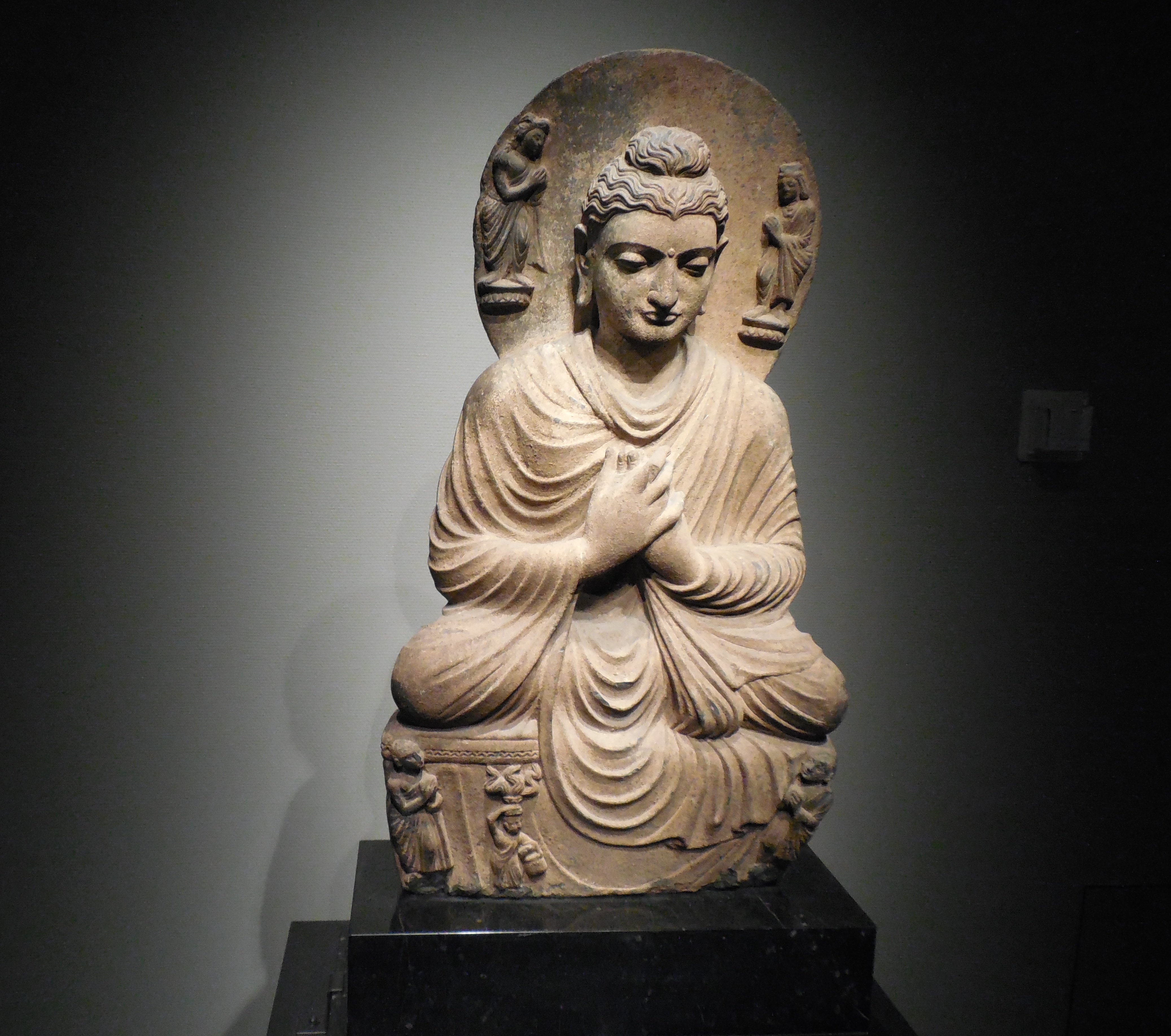
30 Kushan Buddha

I really appreciate that Buddhist lore includes a story that Buddha couldn’t charm his cousin into not trying to kill him out of greed and jealousy (though he could charm the elephant sent to kill him into chilling out and being peaceful).

And another where Buddha couldn’t stop a war that his clan brought on itself that wiped them out.

But Buddha tried anyway.


Kind of rings a bell, doesn’t it?

208

The Enemy of Good Is Better

I first heard the statement ‘the enemy of good is better’ from a mentor when learning to do eye surgery.

To the compulsive or those who tend to feel insufficient or guilty it might sound like settling for mediocrity. Nope, didn’t say the enemy of mediocrity or not good enough.

Good enough is good enough.

Trust the universe to meet you half way.

It means take yes for an answer. If means don’t go after some unattainable concept or image of what is perfect. Trust in doing it right. Don’t futz, don’t get carried away pursuing arbitrary goals or standards of just how good, no, how great, it could or should be.

You will sometime take it too far. You will cause trouble for yourself and others.

Been there done that. And it wasn’t good. And it certainly wasn’t better.

bf1597bf5e38b0a84d20466eecaed8df

Long Week

This has been a pretty long and kind of dramatic week in my personal and professional life. Challenges I hope adequately met.

Details not important. Stuff, you know.

But, whatever I did well or poorly, however I maintained my center, or didn’t, reflects my practice. Because it reflects my life, because it is my life.

What else is there? (See last post! Everything and nothing!)

I do think meditation helps. For me, having the touchstone of  a formal practice helps.

Having a loving family and friends helps too.

Thanks, much love to all.

Shikan-Incense-200


Two Sutras, a Poem, the Brain and Everything

214

I like that Buddhism says that mind, as in brain process, not Mind as in Buddha-Mind, is a sense perception, that the brain is a sense organ, like the eye and ear in seeing and hearing.

The brain is indeed a sense organ in that it evolved to organize energy inputs and channel them to other parts of the brain, just like sense organs do. Only the brain’s output is a context, that is, a story. It is a “meta” sense organ in that it organizes the other senses. And just like the eye can generate it’s own output without “external” inputs (close your eyes and you will see things, colors and lights, generated by random firing of retinal cells) the brain can generate it’s own outputs without inputs; we call them thoughts.

In fact, some would say this is the nature of all of our experience of the dualistic world. We project the universe we experience our brain processes, like the Lankavatara Sutra says.

Too abstract? Try this. Each eye sees only 2 dimensionally. It has to; the retina is a flat sheet in the back of your eye. We project a 3 dimensional world. Our brain compares inputs from both eyes to make that story up. We can do it with one eye, even though there can be no 3 dimensional perception with just one eye. We do it by what we have been conditioned to expect, based on evaluating relative size, shadows, etc. That’s why pictures can look 3 dimensional to us, whether paintings, movies, photographs, TV, etc. It’s why optical illusions work and why one-eyed people don’t walk into walls (at least not a lot more than two-eyed people) and can drive.

How about this? You can’t see a “yellow” photon (that is, a photon at the energy we describe as yellow as shorthand). You have no yellow perceiving photoreceptors. Your brain puts yellow together from various inputs from the retina and projects it back out

Those inputs from one part of the brain (the visual cortex) to other parts of the brain (the visual association centers that put together the world into a coherent visual story) are no different on a brain level than the input of a photon on the retina of the eye that causes changes of energy that are then transmitted to the brain in the first place. Energy in, energy out.

So yes, the brain is indeed a sense organ. Well done, ancient Buddhists!

Lets go wide and deep on this.

first, go small, very deep, to strings, if they exist, we get to just energy patterns. At that level, there are no things, things disappear.

Go wide and big and in the vastness any thing, any fluctuation in the energy, you, the galaxy whatever, even our universe, is so negligible as to be essentially if not actually zero. Like a tiny + and – adding to zero. All change in the realm of what we (our scale of energy fluctuation) can perceive even extended by instruments, is no change at that scale, in the face of infinity, or 10^500 multiverses, or even in our known visible universe, or especially, as I understand it, if there is indeed no beginning no end. At that level, there are no things, things disappear.

So we are back to Shitou and the Tang dynasty Zen poem “The identity of Relative and Absolute” wondering what this vast UNI-verse, this undivided non-dualistic state, and awareness. What is that identity? How do we get to the reductionist stuff from the unified forces or to the unified forces form reductionist stuff? That is true science, the real theory of everything; only it isn’t a theory.

This brings to mind The Diamond Sutra, which says we should not attach to a person, a soul, a defined entity and identity of who and what we are.

To the state of being at the smallest of the small, say a “string” or the smallest quantum fluctuation of virtual particles in the void, at the smallest scale, you don’t exist. That is why a virtual particle, an expression of the vast limitless energy of the void, is “virtual;” it doesn’t feel us and we don’t feel it. Otherwise it would be a particle, not “virtual.” Yet some say that energy is where the big bang, or all existence, came from. It is fundamental. It is “the field.” Others say fields are just concepts that tell us how things act, to do the math (that is, quantum fields can be described by how they work, not what they are). In any case, there is nothing you can do to touch that string or virtual particle, you are too large, too coarse. That smallest world exists in a cosmos that isn’t yours, yet it is you. Yet you only exist as an individual entity (to the degree that you seem to do so) by virtue of the rules of the smallest of the small.

To the Universe/cosmos or multiverse or whatever, at the largest scale you don’t exist. You are too small a blip to register in the unending beginninglessness. Heck, even at the level of the galaxy, our solar system is too small to truly be said to exist as more than a small statistical fluctuation. At larger levels we aren’t even statistically present. Yet you only exist as an individual entity (to the degree that you seem to do so) by virtue of the rules of the biggest of the big.

And in fact, science tells us that there is no privileged time and space, that every point is the center of the universe

That cosmos, the smaller and smaller, or the bigger and bigger, that we can’t seem to touch, is us, because, well, here we are, right dab in the middle of it all.

The ancients would ask a new student “where did you come from?”

Meaning where are you? When are you? Who, what are you?

Good questions. And in some way, science and Buddhism start to converge in the answer.

You are the universe unfolding, without beginning or end, neither here nor there, neither existing or not existing, at least not in the way you think with your sense organs, your day to day relative existence, yet always at the center.

Please, lets take good care of that center!

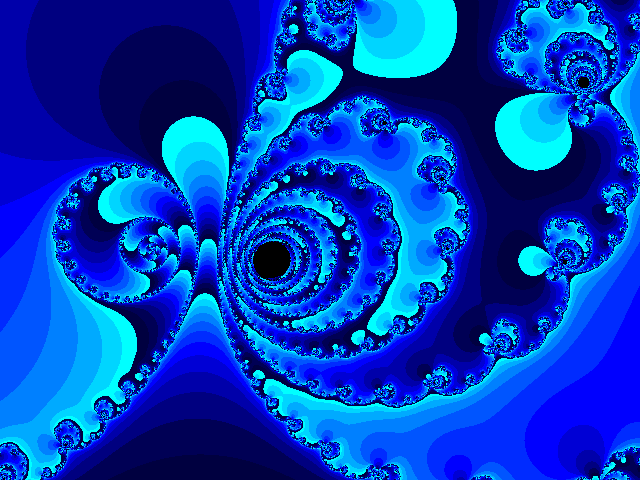
fractal image