Myths

SONY DSC

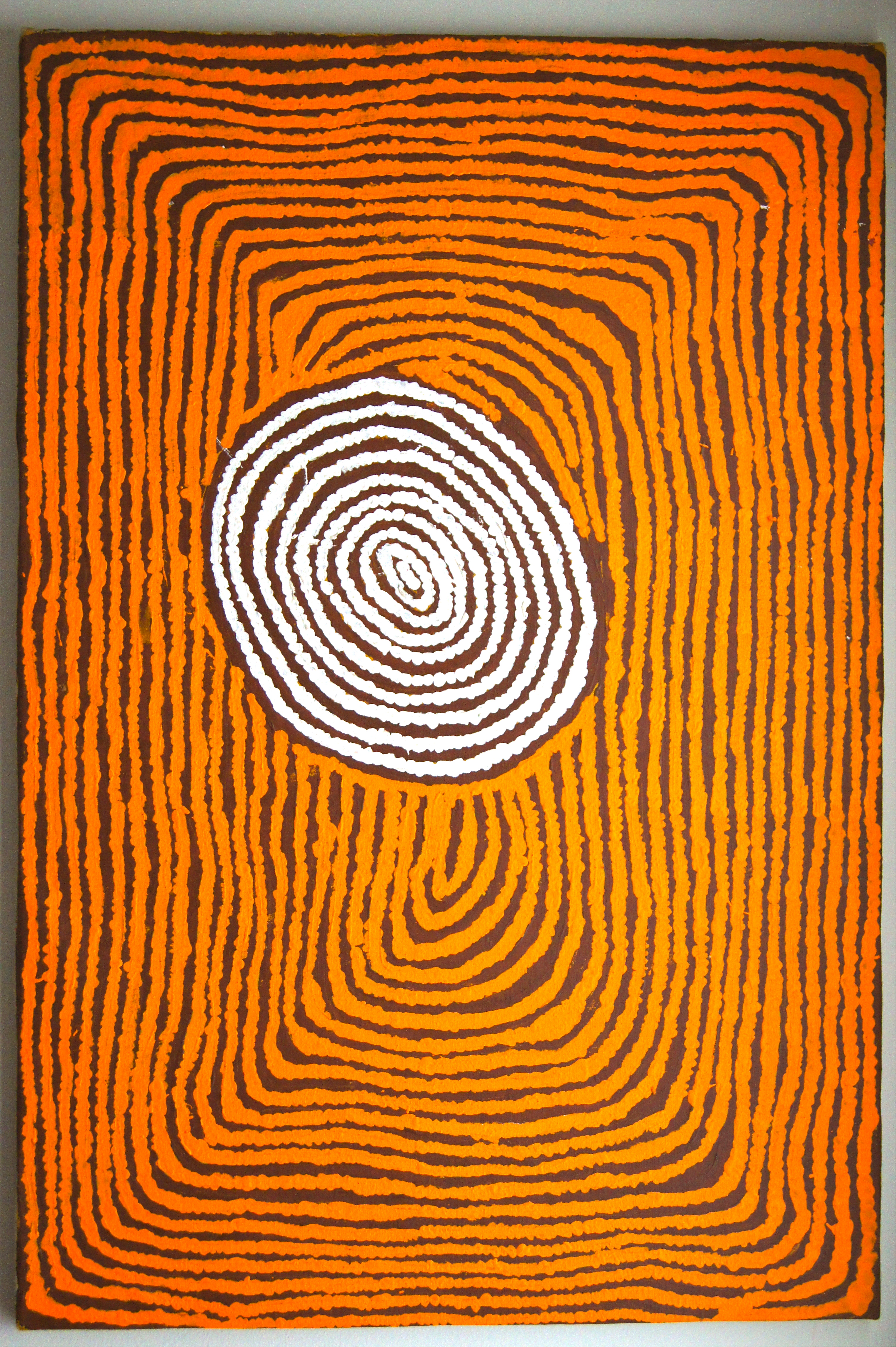
The Seven Sisters by an Australian Aboriginal artist based on her people’s  mythology


Yesterday I visited a friend of 40 years. I hadn’t seen him in years, but my GPS, depending on satellites and the math of relativity theory (that same set of equations that tell us a photon in a vacuum is in a universe of no time or space, well, forgetting about gravitational fields perhaps) got me right to his front door.

My friend, who is my age, has a kind of cancer that should have killed him and indeed was killing him. Chemotherapy failed, although it likely extended his life a bit. That was important because it enabled him to survive to try a new medication, one of the molecules scientists designed to fight cancer through sophisticated cellular targets. So far it is working; his tumors dissolved rapidly and as far as they can tell dramatically.

Science works. It is important not to subscribe to myths that will not allow for that. That is just crazy talk.

So my friend and I were talking about science and spirituality. He is very insightful, but he seemed to be stuck just a tiny bit on whether dark energy or dark matter was what one “sees” with the third eye in meditation.

Well, that’s why in Zen we tend to keep our eyes partly open when we meditate, so we don’t wade in the darkness and try to imbue it was some meaning that isn’t there!

images

Certainly to a scientist that third eye and dark energy/matter connection doesn’t sound right. “Dark” in dark matter and energy just means they don’t give off any light to show us what and where this matter and energy is. We don’t have instruments that can measure them directly. So they are dark to our senses. We “see” dark matter and energy by their effects on the cosmos, like the apparent expansion of space and the ways galaxies turn. Specific, measurable effects, that is.

As I wrote before, for example in the recent post about not being seduced by the cool in quantum, using science this way can just add noise and be distracting.

On the other hand, someone recently suggested a book to me “More Than Allegory: On Religious Myth Truth and Belief” by Bernardo Kastrup. I am only about a third into it. I don’t agree with all I have read, but there is some insight there, and it helped me in talking to my friend.

After all, what is a myth but how the intellect deals with ineffable, what is beyond words? Are myths literally true? Of course they are not. But do they express Truth? Many times, yes, myths can reflect our conditioning, desires and delusions and show us an intuitive view of a road out of our grasping, fearful, limited brains. Not all myths do that, perhaps most, simply codify cultural norms or personal biases. The best myths are how we talk about what we can’t talk about. Myths aren’t only what we tell ourselves in the absence of fact, they are a place we go recognizing that language and intellect are limited by the scale they evolved at.

As written in the foundational Song Dynasty Zen poem “The Identity of the Relative and Absolute” in the translation we chant at Hazy Moon Zen Center (I believe by Maezumi Roshi via ZCLA) “reading words you should grasp the great reality.”

When I started writing non-fiction about science and Buddhism I called my work “Chasing Phantoms.” The title was based on the story of Laplace’s last words. Laplace was one of the top, if not the top, mathematician and scientist at the end of the 18th and the beginning of the 19th century; the “Enlightenment” in Europe. He was sometimes a theist, sometimes an atheist, always brilliant. On his deathbed somebody said to Laplace, “wow you must feel good about having been such a smart guy, accomplishing so much in math and science.”

Laplace replied, “Well, we do chase phantoms, don’t we.” Then he died.

The word he used for phantoms in French was “chimeras.” Stuff we cobble together. Stories we put together from different things in our experience, things we perceive, to make a new thing, a story. A myth.

So while I started suggested to my friend that he might not want to waste his time meditating by looking for dark energy in his third eye, I backed off a bit. Why not go there? Not a bad myth, though I am leery about mixing myth and specific scientific observations and terminology. Like a mixed metaphor, it doesn’t sound quite right to me. Also as a scientist, the situation is not symmetrical. Maybe I can mix science into myth, but it is not acceptable to mix myth into science, if you want your GPS to work, and if you don’t want to do stupid stuff like deny climate change, over population, pollution, thereby threatening civilization. Be careful you don’t lay your delusional myths born of greed anger and ignorance on science.

Yet I relish myth and I love science. Many of the sutras contain myths, stories that are not necessarily literally true but aren’t merely or solely allegories. The Avatamsaka sutra (and others, but I happen to be looking at that one) is full of elaborate images. There is’t a literal Mount Sumeru on earth.  I love referring to Guan Yin, the bodhisattva of compassion, and stories of her going down to hell hearing the cries of the suffering. I dig the story of Buddha putting up with his murderous cousin and trying to stop a war and failing. I act as if true, though I understand they are not “verified” by archaeology or written contemporaneous sources. They aren’t academic history or scientific experiments or even mathematical models. As Nyogen Roshi says, they are about you. Like myths.

images


Did Shakespeare write Shakespeare? I think so, but then again, really, who cares? Whatever myth you believe about who wrote the plays isn’t critical to me. If some new facts come to life, I’ll change the myth in my head. Until then Shakespeare is a myth that works for me. It doesn’t for others. Above all, the play’s the thing… (paraphrasing Shakespeare), and all these are just such as dreams are made of (oops did it again).

At its furthest reaches science is myth. That is, we take observations and cobble together a story that supplies a deeper understanding beyond the limits of data retrieval. That is just what myth does.

While I do not always realize I am myth making in my head, being a scientist and all, I very consciously wrote a myth when I wrote my novel for kids with the express purpose of creating chimeras full of heart and meaning (“Aidan and the Dragon Girl Save the World”). The novel I chose to write isn’t a work of science fiction (the obvious choice one might think given my background in medicine and science), it is a fantasy, a dream; it is a myth. And like myth, the story works best, as does all fiction, if you take it as true when you are reading it.

images-7

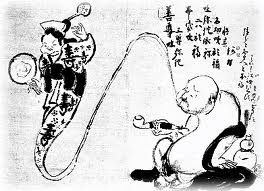
Hakuin Zenji understood the value of myth

The tetralemma, basic to Buddhist logic says of such Truths, the chimeras, all belief systems the human mind cobbles together, including dogmatic Buddhism, not true, not not true, not both true and not true, not neither true nor not true.

That is Myth.

Now, in Zen, in the original, earliest Chan writings that we have, we are to cease notions. I get that. We are easily misled, easily seduced by stories and usually they are there to serve our egos. Dualistic distractions. So fine, maybe I am a bit off base here. On the other hand, as Nyogen says, much of practice consists of gimmicks designed  to shake up our parochial views, our day-to-day delusions, to push us beyond our conditioning. Maybe used right myth is upaya, skillful teaching. A piece of the raft we cling to to get to the other shore, in Buddhist jargon.

So if my friend likes shutting his eyes and picturing dark matter in the depth and silence of his third eye, maybe it’s not so bad. I mean, it could be worse, he could have decided string theory is the multidimensional Buddha.


fractal image


Information and Entropy: Be Careful What You Ask!

images

Some say that the universe itself IS information. That way beyond our dependency on information as individuals and as a civilization, information is essential, is fundamental.

Certainly no information is very boring, very static. A basic yes/no 0/1 opens up all of computer language, but no variation of 0’s and 1’s, just a universe of all 1s or all 0s, doesn’t get a computer program very far. No information, no this and that. Certainly information is the realm of the relative.

Some say entropy is the heart of any first this then next that, that entropy defines time itself. Though I, and many philosophers and scientists and other deep thinkers like Lanza and Dogen don’t think that is true, that time is essentially just entropy, it is just as true that entropy certainly plays a role in our quotidian experience of time.

While Humpty Dumpty falling off a wall and breaking is an easy and quick thing, it is hard to put back Humpty Dumpty together again. Broken Humpty doesn’t just scrunch back together and fly up that wall, sitting pretty and smiling widely again, after the fall. It is possible for that to happen, but it is really, really, really very unlikely.

If you drop an egg and film it, you can tell pretty much if the film is then played forward or backward. Very rarely you may be wrong. Simply, broken eggs are more disordered, breaking them took little energy to make happen, just open your fingers and gravity does the rest, but an intact egg is very ordered, and took a lot of energy (ask mother chicken) to get there.

Entropy captures that difference qualitatively and quantitatively. It evolved in thermodynamics (for steam engines, trying to understand what all that inefficiency and wasted heat was about)  as the statistical likelihood of a state evolving due to there being more “disordered” than “ordered” states in a system.

As a rule of thumb in physics and chemistry, entropy is really good and implies this then that! No engineer can ignore entropy and keep a job.

Information theory also uses entropy as a quality and a quantity to be reckoned with. So how are information and entropy connected? Is it in some sense related to heat wasted, energy spent. Yes, computers heat up and energy is spent, and organization, efficiency  and predictability are all part of it. Information Theory was first interested in the efficient transmissions of signals in communications. What was important was whether the message, the information, the data, the signal that was sent was the one received.

To start, you could say  high entropy is a measure of little information, great disorder, hence ignorance, at least of the details. You can see how such ignorance may impact a message and the information sent. To get an intuitive grasp of this is pretty easy, as is seeing why our perception of time is influenced by entropy, order and disorder, at least relative order and disorder, going back to Humpty Dumpty. When the egg breaks the yoke is all mixed up with other stuff, shells and albumin, sticky and hard to tease apart, hard to say just where all the yoke is.There are, of course, many more ways for the molecules in a smashed egg to be mixed and splattered than in an intact egg where yoke is here, albumin there, all neatly wrapped in a shell. That’s a measure of higher entropy of Humpty Dumpty having fallen. And it helps predict which chemical reactions will go which way and how much energy will be wasted in heating up the atmosphere by your engine (or your computer, or your brain, for that matter).

Information theory is at the heart of computer and communication science and needs a more quantitative understanding of ignorance and entropy. We need to know the probability of surprise, and so the extent of ignorance of what happens next.

Information theory, a great intellectual and technical insight by Shannon decades ago, says that the amount of surprise in a message relates to entropy. And in this, entropy relates to ignorance, because you are only surprised if you don’t know what’s coming. You don’t want surprises popping up in your message if you are in charge of communications! You want what is received to be the same as what was sent, no issues of garbled text.

All of this also suggests that it matters, to some extent, exactly how you ask the question of the system about how much entropy there is.

I am not surprised if a fair, six-sided die with a different number on each face and those numbers are the sequence 1 through 6, comes up with a number 1 through 6 when I role the die. So if that’s the question I ask is, will I get any number 1, or 2, or 3 or 4, or 5 or 6 on the next role of the die, the answer is clearly yes, of course, and simply reflects that I asked a trivial question of a simple system I understood. Probability (p) = 1.0, 100% sure. No ignorance, no high entropy, and not very interesting, either. If I ask whether I will get an even number on the next roll of the die, there is a bit more uncertainty. I have a 50:50 chance of an even or odd number. That is less ignorance and lower entropy than if I ask if I will get a 5 on the next roll, which is only 1 of 6. In this situation the outcome is random. I am not surprised whatever number I get here either, as any number can come up. But my surprise with this question is different from when I asked if I will get any number, but not very different. Same basic conclusion, just asked a different way.

Now if I ask if will I get a number other than 5, then the answer is on average I will 5 of 6 times I roll the fair, unbiased die, I will get a number other than 5 with the probability of 5/6 for each roll. Good odds, so little (but some) surprise when I get a 1 or 2 or 3 or 4 or 6.  Lower entropy, less surprise, and less ignorance. If I don’t get a 5 I am not so surprised, if I get a 5 I am surprised and delighted if money was riding on the outcome. Same system each time, a six-sided die with each face having a different number 1 through 6, but different questions, and so different ignorance/surprise/entropy.

But notice the 1/6 is of a 5 on the roll just 1, the probability I will get a number 1 through 6, minus the probability of getting a number a number other than 5. And vice versa! SO these are related. We have constraints based on our question, our delusions don’t come into play, we don’t set the odds however we like them. We can set the system up with an unfair die of course.

An important idea scientifically is that we have to explain any deviation from random in a system. There is random, then everything else on a continuum of probabilities, of more or less ignorance of the outcome before we roll the die, before we send the message.

So, low entropy is good, right? Entropy is disorder, entropy is ignorance, and we don’t want that. While what we want does matter to engineers and programmers, and to us if we are pure of heart and mind, seeking a way out of suffering for ourselves and others, does it define good and bad to the universe, in terms of the unfolding of creation?

Not necessarily.

As in the entropy as an answer to a question about our ignorance and about randomness versus certainty and all between changing depending on the question you ask of the system, as in the results of a quantum experiment revealing a particle or a wave depending on how you ask the question, so does the answer to whether entropy is “good” or “bad.” What you are asking and how the answer comes back matters. And the universe may not be asking the same question as your monkey brain at any given moment! Maybe that’s our practice, aligning our questions with those of the unfolding universe!

Maybe you create entropy and ignorance with your expectations!

Anyway, I suppose low entropy is good if you don’t like surprises, but it is a kind of boring universe that universe of all 5s.

We think we want certainty. Perhaps that is an illusion.

Now, say we go back to that fair six-sided die with a different number on each face. Large entropy if I ask whether a specific number will come up next. I have no idea which number from 1 to 6 will come up next, so large ignorance, room for surprise! I get more information each roll than with the all 5s die: I get information the die was rolled (because there is a new number 5 of 6 rolls) and I discover the resulting number. If I play a game where a 5 wins, every game is life anew. Not so in the universe of all 5s. No games, no surprises, little information.

As for the symmetry test, the one that says an object is symmetrical if you can’t detect a change when the state of the system is changed (say a circle rotated when you aren’t looking), I will know 5 of 6 times whether you rolled the die (in 1 of 6 rolls on average you will get the same number), so again more information obtained there and less symmetry as well with the die with different numbers on each face than the one with all 5’s. Symmetry is associated beauty and the absolute, the unending. But it is in the breaking of symmetry that we end a certain kind of ignorance, where things happen, where circles become waves and waves become all things..

Is symmetry beautiful and useful? Kind of depends on what we are looking for, what questions we ask; our state of mind, as it were.

Not so straightforward, this ignorance, symmetry and entropy thing. Those who study chaos theory and complexity theory say the best stuff happens at the edge of chaos. Too random, can’t sustain anything even close to life. Too static, no change, just same old, same old.

After all, a single tone has little entropy, is very organized with no surprises, we know what comes next exactly, but it isn’t the most fun music. Similarly static that is randomly generated has endless variation, is not organized, but it also can be pretty annoying (but some people thrive on “white noise.” Go figure) and wont hit the top 40 on the charts.

So entropy can be computed, and ignorance and surprise can be quantified Computer science and communication science (where this came form) depend on it. But what does that really mean?

We seem to need variation without total randomness in our music and our stories. And what are we without our stories? Maybe liberated? Maybe awake? Maybe it is our state of mind that counts? There is the story about where at UCLA when the studied his samadhi they were shocked that Yasutani Roshi found each tick of a metronome to be unique, he didn’t adapt to the repetitions, didn’t experience them that way. He seems to have experienced each tick as existing in a universe that is never the same, always changing. No expectations, perhaps. Being truly awake, perhaps.

 “What does it really mean?” is a trick question. There is no really mean. The problem is that when we think in terms of values as determined by our evolved monkey brains, we are constrained by our perspective and scale of living, the way we like our stories. Something happens and we ask ourselves, gee, what will happen next? What does it imply for me, my sense of well-being? A reasonable question of course, and that’s why we evolved brains to ask and answer it. Does that noise I hear in the bushes mean a lion will jump out and eat me, does that rhythmic sound coming from my husband encode words that I should interpret to mean that he doesn’t love me anymore? Or is it just atmospheric conditions generated by sunlight heating the air above earth and sea unevenly creating wind shaking the leaves that I hear, my husband clearing his throat, expelling bursts or air, nothing more? The meaning of information in that sense is what we project on the universe with our monkey brains. It can be very useful, it can be critical for our health, happiness and survival as smart primates, but is again, like the entropy of infomration  depending on the question we ask of a system, the meaning of information is also dependent on our expectations, hopes and fears.

And on top of that, we are kind of lazy sometimes. Well, all things (composite things, Buddhist might say, deep impermanence) tend toward lower energy (oh, and higher entropy as energy is released as unused heat and composite things come apart). Both the word ”random” and the word “unchanging” take about the same time and effort for us to say and both things will be boring to us. So in that sense what we might think of as information when we address it with our usual language is about the same whether it is randomly generated white noise or a single sustained note; since both would be annoying over time and would have very little other import to us, we may think they are about the same. Since a random weather report and one that never changes regardless of the state of the local atmosphere would be equally useless (though both would be occasionally right, like the broken clock twice a day) we think they have a similar lack of information.

But both have a history, both contain information we may not perceive. How is the random noise generated? What is keeping that note going?

That’s how it often is. We project our day-to day experience on the universe. We decide on what is true and useful based on our brain and body needs, our need for a weather report that tells us whether to wear a coat or plow our fields, or our need to be entertained, our need to feel certain ways (loved, special, comfortable).

Information, the universe, is not sentimental or goal directed in the same way we are. Our self-perceived needs, our ego’s delights, are not primary, but rather a subset of the functioning of the universe. Our minds may be totally entangled with the universe of Mind, but the universe need not respect our biases.

The universe of Mind or consciousness, of Zen or Biocentrism, need not be designed in some dualistic fashion by a separate designing entity to live on the cusp or chaos and order. It doesn’t necessarily use information and entropy as we would ask it to, our questions born of our karma and desires, our craving and our fear.

Mind is not defined by some human definition of “intelligence,” consciousness need not be “smart” in human terms (intelligence is a dicey concept at best), though Mind contains and embraces human intelligence.

Equally, information is not inherently goal directed, it is simply question directed. Our egos have goals, our perceived needs, and these determine the questions we ask. That’s our problem, our need for interesting stories that make our lives “better” in some imagined way, that make sense to us in terms we dictate, often based on total delusion, though it is true that information does have value in our goal to be compassionate and live our lives with grace when compared to ignorance.

Of course, that idea of information is important. If we want to live with “no self deception as Maezumi Roshi exhorted us to, and I think central to Zen practice as I understand it and as taught by Nyogen Roshi and others, we want good information with minimal static. Ignorance is one of the poisons in Buddhism. This is also why scientists and others worry about intelligent design (religious dogma in scientific garb, a Trojan horse of the religious fanatics) and superstitions that lead to grave errors and great pain. I do not mean to say these things don’t count. This has not reached the level of functioning of some of the most powerful people in the world, and to many voters around the world, to our great peril. Hence we get climate change deniers, a president that eschews reality, racism run rampant, overpopulation, talk of a renewed arms race just as we got Iran to back down from nukes and hope Korea some day just might, and you can fill in the rest, there are so many examples of willful ignorance to serve greed and enacted out of fear.

After all, Buddhism does concern itself with pain, suffering and compassion and being awake, an end to ignorance!

I’m just saying the universe isn’t sentimental about it. The earth would be fine without us. A supernova destroys worlds on end but creates many of the atoms we are made of. Information is found in random noise.

None of this excuses us from taking responsibility for knowing what it takes to decrease suffering and wake up.

In the realm of the relative is entropy a “bad” thing? It inherent in change, it is the manifestation of form; it is the world of the relative. It is where things happen. Bad vs. good isn’t too helpful a concept in this context. Like the Tao, it has no difficulty, no obstruction, just avoid picking and choosing, the poem the “Xin Xin Ming” of the second patriarch says.

So take care with what questions you ask, your assumptions about good and bad, symmetry and beauty. Watch how you ask your questions, and what you do with the answers.
 

208

No Time, No Space, No Problem

Slide3

A riddle:

What is so small that you cannot measure any dimensions, and has no mass; you can fit any endless number of them in one place, yet it can extends across the entire universe with no time elapsing and with no intervening space; that exists in a real sense without space or time, yet it is real and you can experience it directly and your very life, your very existence, is dependent on it?

Maybe a thought fits that description? Or God, if you lean that way? Or Buddha Mind, or the 8th Riki, Alaya consciousness, the Akashic record?

Sure, seems to fit.

Or a photon. That fits, too. Light.

A photon, the force carrier of electromagnetic energy, that also carries energy from fusion reactions between atomic nuclei that occur, say in the sun, fueling photosynthesis at the base of the food chain (well, at least our food chain; other forms of life can depend, for example on thermal energy, for deep sea vents, but one can argue that is indirectly form nuclear reactions in the earths core). The infrared photon that you feel as warmth on your skin, and the higher energy  photons of visible and ultraviolet light that make vitamin D in your skin and gives some unlucky people a melanoma. The particle that powers the photoreceptors of your eye so that you see your loved ones  (well this is more complicated; as Buddhist philosophy makes clear there is sensation but then conception, discrimination, awareness. The photon is how you see your loved one but that is not just a matter of photons and photoreceptors. As cognitive psychology, neuroscience, quantum physics, the Lankavatara sutra and Biocentrism suggest, you project, of course, you are creating your world of loved ones. Well, we also chant in the Heart Sutra: except in emptiness where there is no sensation, conception discrimination, awareness. But I digress).

The photon can detected  in the detector of a double slit or interferometer experiment (though so can objects with mass, protons or electrons, atoms, Bucky balls, etc.) in physics that reveals to us the mysteries of non-locality and entanglement. A particle that is so focused and localized that it can knock an electron out of an atom (the photoelectric effect that Einstein won a Nobel Prize for), but that is just as much a wave without defined boundaries, until it interacts and is measured. A wave that can interact with endless numbers of other waves in the exact same place and time. A particle that can also be stacked in infinite numbers in the same time and place (a “lepton” with no dimensions, no mass).

A photon, the “particle” or basic unit (quanta) of light, does not exist in time or space.

The basic algebra of special relativity is clear and experimentally validated.

In the denominator of the Lorenz equation of special relativity for the effects on time and space for objects in motion (and vice versa; see, for example, the appendix in Biocentrism by Lanza and Berman) there is a mathematical term: the square root of 1, representing the speed of light (c) minus the relative speed of an object of interest (well, velocity (v) relative to the velocity of light, but no difference between velocity and speed here for us; velocity is speed with direction, and here that just says both the speed of light and the velocity of what we are interested in are moving in the same direction)  So, if we take the speed of light to be 1, the speed limit, and the speed of the object is some fraction of 1 (how fast it is moving relative to the speed of light), and that object is also moving at the speed of light (as it would be for a photon), the result is the square root of 1-1 = 0 in the denominator.

Well, you can’t divide by 0, it is not allowed they tell us, so right there we get a mathematical absurdity, as the photon does of course travel at the speed of light, it is light. In any case, any mathematical absurdity notwithstanding, as the denominator approaches 0, that is, the speed of the object approaches the speed of light, the time dilation approaches infinity as one expects when one gets some number over 0. 1 over a very small number is a very large number (1 over 1/2 is 2, that is, 2 halves make 1, and 1 over 1/10 is 10, as ten tenths go into one, etc., ad infinitum, as they say).

At the speed of light a tick to tock for that object, that photon, takes forever. The tick to tock can be any measure of “time,” which means in our experience any regular, repeating event we can observe (a tick-tock of the second hand on your antique pocket watch as the spring uncoils, the swing of a pendulum, the time of orbit of the moon around the earth, the half life of a cesium atom, the days of our lives, etc.). The tock never comes as long as the photon is free to do its speed of light thing.

That is the reason for the “twin paradox” you have probably read about that says that if a twin that goes on a journey in a fast moving spaceship, she is younger than her sibling left behind on earth upon her return. Equally there is a proportional length contraction; the faster moving object is squished. As pointed out in “Biocentrism” page 115, if you were to run across your living room at 99.999999% of light-speed, “your living room would be 1/22,361th its original size…barely larger than the period at the end of this sentence.” Yet to the inhabitants of that living room time and space would not respectively seem dilated and squished. “It’s all good,” they would say, “nothing different here in our friendly little living room.” Same for the twin in the rocket who didn’t age as much as her sister because the tick to tock took longer relative to her sister’s so less ticks became tocks, and who was similarly squished relative to the space experienced by her sister. “All good,” she would say. “Ticks become tocks, and I am not squished. Just as it ever was.”

Well, it’s not that simple; the twin on earth is essentially moving away from the twin in the spaceship just as fast as the twin in the spaceship is moving away form earth, just in the other direction; that’s relativity! The living room is moving just the same as you are, but in the opposite direction. Seems perfectly symmetric, so why don’t both twins or you and the living room have time dilation and length constriction relative to each other? How would that work?

The answer is that it isn’t perfectly symmetric for all entities involved. It is a question of how the system of two twins or the system of you and the living room got where they are: the twin in the spaceship accelerated relative to the twin on earth and you accelerated relative to the living room. The two twins both started in the same place and time but only one blasted off, accelerating into space, and you started at rest at one end of the living pumping your legs as you left off the starting block running. In both cases, the space-travelling twin and running you, used a different amount of energy from the other objects in the system to get things started, to get things moving. So it isn’t a perfectly symmetric situation in either case. [This energy portion can get us to that E=MC squared thing of general relativity and how a massless photon can effect space and gravity, but I digress]

Karma!

Back to the photon! Some small percent of the static on your car radio comes from photons that are almost 14 billion years old, as old as the visible universe we can measure. Yet for an object moving at the speed of light time dilates so much that a tick or tock takes forever. Tick, but no tock, not ever, until it slows down, say hitting your cornea then your lens then your photoreceptor if it is of certain wavelengths, or becomes static on your radio of photons with the energy of about 3 degrees above absolute zero). Almost 14 billion years? No tock, no worries, no passage of time, effectively no time. And space? The photon’s space is squished to nothing. No space. No time no space.

Only objects with mass can experience time and space. An object with mass cannot accelerate to the speed of light because the faster it travels the more the mass, as if it picked up mass with increasing speed like snowball effect in a cartoon as a rough analogy; as the snowball rolls down hill picking up more and more snow and getting larger and larger (ignore momentum and gravitational potential energy decreasing and kinetic energy increasing for the snowball speeding the snowball up for this analogy, maybe better think of you rolling a snowball along level ground, though that image isn’t as much fun or dramatic as a cartoon snowball rolling downhill picking up trees in the process, chasing our cartoon hero). So as an object with mass approaches the speed of light the mass of the object would approach infinite mass and so become harder to accelerate and eventually impossible, making the speed of light an unattainable goal (think of mass as a measure of inertia, i.e. how hard it is to get things going.).

That’s where the Higgs field comes in. That is mass. The moving object picks up mass in the form of Higgs bosons like the snowball above. So maybe Higgs is really the Un-God particle, the particle that gives us gravity, space and time. It gives us the experience of life and death.

No mass, no time, no space. The entire universe is here and now, quite literally for the ubiquitous photon and other massless entities (the photon is not alone, just the one we depend on in our lives on earth), there is no there or then.

So how big is photon, a wave, a quantum field, a particle that is without mass, the smallest thing, if thing it is (it isn’t, of course)? Smaller than can be, as it has no mass or dimension as a particle, yet as a wave it is larger than all that is, as a wave it has no bounds. At the same time, it is neither big nor small, since it does not exist in time or space. This is Indra’s net where all interstices are jewels that infinitely reflect all light instantly. Until it registers in your eye or as static you hear. Then it is in your massive world of the relative, of quotidian experience. Your eye that brings the photon released from a star light years away into temporal and spatial existence, mind creating a world of light! Until then, as far as you and that photon are concerned, the star had no existence in time and space.

Crazy world, huh?


images


Beware Being Seduced by the Cool in Quantum

Slide3


I have written about the fascinating and weird quantum mechanics of double slit experiments and entanglement. Gotta love it!  I will write more about quantum mechanics, time, far out speculations, and I am thinking more and more, along those line about entropy. Entropy is often thought of as a measure of randomness, disorder, and in information theory, ignorance. It seems to be on the one hand trivially statistical and on the other hand deeply embedded in our experience and how energy interacts with energy. Some think it is why we perceive time. More on that later. I have some more thinking to do about that first.

Part of what has inspired me in that direction is a book I am reading now, “Now, the physics of time” by Richard A Muller. I just came to a part where he wrote about the worst theoretical prediction in science, and it was a result of the mathematics of the most beloved and trusted theory, quantum mechanics. It concerns dark energy and the predictions as to whether quantum vacuum fluctuations, the variations in energy and virtual particles demanded by Heisenberg’s uncertainty principle and seen experimentally, could explain the accelerating expansion of the universe we seem to observe. This would be instead of dark energy, a kind of negative gravity that is also quite speculative but would better explain recent observations about the dynamics of space and galaxies at the scale of the visible universe. Well, the prediction of the magnitude of the effect of these quantum vacuum fluctuations on the expansion of the universe was off by 10 with 120 zeros after it. That is one big number! That isn’t just wrong, that is bizarrely, sarcastically, profoundly, embarrassingly wrong.

He points out this has been called the “worst prediction in the history of physics.”

Well, quantum mechanics does describe some things exquisitely well, but there is a reason that scientists in some cases spend their careers on speculative mathematics such as string theory. And while we can’t deny the wonderfully tantalizing hints about reality that quantum mechanics serve up to us, we have to remember it isn’t infallible. It is a reflection of the questions we ask. Ask the right ones, it gives great answers. Ask others, it gives answers that surprise and delight and tantalize. Ask yet others, total nonsense.

And that is my main point! So you don’t get quantum mechanics? Well, you can’t get it! It is at its best a great tool but as fare as understanding reality, mind, consciousness, and who you are, it is still just a peek. A peek that is important because it reminds us that the solid, this and that, this then that, the material, the existence of linear time and space  as we experience it in our daily lives, is not quite how it is, that it is an illusion of our sureness, of the scale we live in.  Now, somehow my last sentence was autocorrected but I liked it! I meant to write “illusion of our senses” and it spit out sureness. OK both work, and maybe an illusion of our sureness is even more accurate!

Anyway, that’s how I approach it. Nobody really thinks science can give us a final answer that is experimentally valid. The energies involved are technically not feasible, but beyond the technical limitations, we are limited by demanding answers that fit our brains. No experiment can get outside “reality” to measure it.

To me quantum mechanics, beyond how it helps us make better toys, is just a hint that what we perceive and measure is not how it really works.

It is kind of liberating. How do you see the universe when you know time and space and the nature of what you perceive is the tiniest slice of the pie and sometimes so wrong it is “not even wrong”? How crazy is it when science leads us to that precipice?

I am not so concerned with all of the interpretations, though I will read about them, share them, and get mind blown by them, but they won’t ever prove anything without some uncertainty because they cant ever be certain. And I don’t think that is just due to technical limitations, but limitations of what we can grasp with our senses, however expanded by technology, as being observations in time in space, defined by time and space, experiments performed in time and space, themselves dicey concepts at best.

But besides being mind-blowingly beautiful, elegant, interesting and of value in reminding us of our limitations, if nothing else, quantum mechanics reminds us how deep and profound and unanswerable by the intellect that the very fact of existence, the very fact of consciousness, at its root, is.

It isn’t permission to think every silly delusion you can come up with is therefor true or has equal probability of being true. But it does mean that it is a wild and crazy universe and allowing yourself the freedom to explore the craziness, to embrace and transcend the craziness, to not be limited by the paucity of data, the lack of imagination, the concrete materialistic linear time and space thinking, and certainly to go beyond the dictates of the metaphysics of scientists who disagree with each other (e.g. string theory anyone? Time and space a real entity? Well, certainly not every scientist agrees!) seems a “reasonable” approach. Not that “reasonable” has all that much traction when we get to the level of quantum mechanics, horrible errors, and unproven theories, whether string theories, multiple dimensions,  branes etc.

We can be liberated by the weirdness, and needn’t be limited by the limitations and definitions of what seems reasonable, which will change from one scientist to another when we are at this level of science.

Note that I am not talking about technical, cool observations like discovering exoplanets, or important matters that can be measured and assessed with the tools of science, like the effect of immune therapies for cancer on the pathogenesis of ocular inflammation, and when seemingly paradoxical effects are seen, as me and my fellow researchers have, understanding what that means therapeutically and for how the immune system works (a current research interest of mine), or for understanding and trying to deal with issues like water use, climate change and other environmental problems (bees, date pollution, health of the oceans, etc, etc.), for example. Deny this stuff at your peril and at the cost of great suffering.

I am talking about how we try to answer the big questions of our lives, and science won’t do that. It can approach it, but never reach it. It isn’t built for it.

At the core, it is about who you are that counts. And while that entails quantum mechanics, it isn’t limited by it.

What is it that  “is”? What is consciousness, your very experience of being, what it is like to be? Is that limited by our senses, by time and space, when time and space are themselves called into question by science?

What really is life itself, beyond a working definition of replication, carbon bonds, information, variation, and handwaving ideas like “emergent properties”?

Cool as the quantum world is, as much as it is our world, there is more, it isn’t the whole story.

Or maybe there is less.

You, however, are the whole story.

Shikan-Incense-200


Quantum Mechanics: Not Just Kinda Cool But Essential to Life

98

It has long been clear quantum mechanics (QM) effects are basic in life. This was something I have taken for granted from what I learned starting in pre-med about cellular biology, though research bears this out in many new and interesting ways.

An interesting recent book about some surprising quantum effects in biology i s”Life on the Edge” by McFadden and Al-Khalili.

As I have written here before, life is energy and energy transformations (well, everything is). Cellular life uses reduction/oxidation reactions as energy “currency”. These reactions are basically the passing along of an energetic electron. They are the same kinds of reactions that causes fire to burn (which is why you need oxygen for a fire), or iron to rust. As Nick Lane writes in his book The Vital Question energy, evolution and the origins of complex life:  “electrons [in oxidation reduction reactions the cell uses to capture energy when oxidizing fuel i..e. food] hop from one cluster to the next by quantum tunneling”

The clusters he is referring to are proteins containing iron that are critical in accepting and passing on electrons.

This electron tunneling, these reactions, are the foundation of life, as we know it anyway. It is the very basis of energy used in all cells on earth. Bacteria, plants, us.

In quantum tunneling particles kind of “cheat” an energy barrier to a chemical reaction by just going through the energy barrier or wall rather (metaphorically) than over it. That is, it pops through the wall where without QM it shouldn’t. To clarify: most chemical reactions need energy to get going. If an electron is involved, say, as is often the case, for example in the oxidation/reduction reactions critical to life (or for example when a photon stimulates a photoreceptor in the eye) the reaction only happens if there is enough energy to get it going, to kick start it. But this can be skirted a bit by the uncertainty, the indeterminacy of QM that allows the electron (or photon) to be in unusual or unexpected states of being. By classical chemistry and physics, that shouldn’t happen, making the reactions much less likely, if they would happen at all, under normal circumstances.

That is, no QM tunneling, little or no passing of electrons from protein-iron complex to another, no usable energy for living things on earth.

By the way, we do use only a light bulb’s worth of wattage of energy to power our entire body, as Bob Lanza points out in “Biocentrism”. But still,  that is 10,000 times more energy per pound than the sun puts out! That’s because the sun is mostly just a big old ball of gas molecules just bouncing around at any one moment not putting out any energy (just being pushed around by the energy released by the nuclear reactions at the center of the sun). On the other hand, all living cells are prodigiously generating and using energy just to stay intact. The way cells store energy is in bonds between phosphate groups in ATP (adenosine tri phosphate) molecules, and a single cell goes through 10 million ATP molecules per second on average.

At its core life is quantum tunneling. It’s all energy.

Very Zen.

images-3


You Think You Can Find Here and Now?

IMG00090-20100605-1212

A building in the former East Berlin

It is easy to see that our idea of the future is simply probabilities and assumptions. It is also easy to see the past is stories we tell ourselves and can’t be found except in effects in the present for which we assume causes in the past. Neither has firm, concrete, reproducible reality, even if they seem fair enough approximations for day-to-day activities and decisions. For “practical” purposes, you might say.

But we are aiming to be living in the here and now, right?

There is a now we experience of course, isn’t there?

Are you so sure?

No matter how brief, there is a finite time, a gap, between event and experience, stimulus and response, energy change and sensation and perception. One study says the brain can integrate a simple visual scene in as short a time as 13 milliseconds, though most studies have suggested it is closer to 100 milliseconds. I suppose there are many factors at play for a given scene and brain. It certainly feels instantaneous, but that’s what our brain does, of course. It fills in the gaps.

The same goes for any sense. Impulses from sense receptors release chemicals that then change the physiology of a nerve creating electoral impulses and ions race in and out of the nerve. That nerve then signals others, which end up in some brain center ,which then sends signals to multiple brains centers. Some time after that, you put words on it and tell yourself a story about what is going on. That takes longer than 13 milliseconds of course; words are slow cumbersome things even when you think them.

So by time you see, hear, smell, taste, feel, think something, it is already past and you are anticipating the future.

Can we know the now? Sure for practical purposes. We don’t want to get lost in futures that may never happen or obsess about a better past we wish we had, so paying attention to something that seems ongoing and most proximate seems a good idea.

But lets not fool ourselves. Most of what we call the present is really the past, and we are already dressing it up in words and stories and anticipating the future when we think we are in the now.

And related to perception and time, is space. We speak of space-time. The here and now. No now, does here get a bit slippery too? Of course it does. Here relative to what? We know space seems to bend, expand and contract given relative motion. That’s Einstein’s relativity and the details aren’t important for this discussion. But I think it is instructive to look at one of the most basic of all entities in science, the massless energy quanta of light, the source of all we see, the embodiment of what we think of as color, the force carrying transmitter of electromagnetic energy, the photon.

There are many ways to look at the phrase “name the color, blind the eye.” The most obvious is that when we dress up an experience in labels we loose the immediacy of the experience. We pigeon hole it for future reference, falling into a dualistic trap. It may be useful if you are trying to paint a picture and want to be efficient in choosing what tubes of paint to open, but that’s about it.

There’s another way that color is a dicey concept that I like, and I think it is very telling about how things work regarding our dream of time and space. You probably know about the Doppler effect; most up us have experienced a sound becoming high pitched as it races towards us (a siren, for example, or a car), then becoming a lower pitch as it races away from us. The waves of air that make up a sound are in effect compressed as that sound comes toward us, then stretch as it goes away form us.

So what is the sound “really”? Is the high pitch sound or the low pitch sound more real? Of course neither, they both are predictable effects of motion. But it does make it hard to talk about THE sound the car or siren makes (even not taking into account all the modifying features of the environment, the atmosphere, other sounds, your ears and most importantly, your brain that turns the energy pulses in the air into sound then tires to make snense of it and relate it to your prejudices and conditioning).

A similar thing happens with light. You may have heard of the “red shift” in the light from stars as galaxies race away from us. Well, this happens all the time. You can only speak of a photon of a given energy being a certain “color” if the object creating that photon and your eye are perfectly still relative to each other. If that object is moving toward you (or you to the object, or both to each other, doesn’t matter, the photon doesn’t care. Relativity and all that), it shifts to blue. If it is moving away from you, it shifts to red. Same photon, full spectrum. Sure, this effect is too small to percieve at most speeds, but it is real and universal. The photon is no one color, no independent color. It all depends on the relationship of the observer to the photon.

And of course we are always in motion. Breathing, heart beating, land masses moving, earth moving, solar system moving, galaxies moving all relative to each other, Indra’s net of interconnections.

No past or future, and even now is a dicey concept. No there, no here, no in between.

Are you sure about here and now? Sure we want, as the Zen saying goes, to occupy the ground we stand on. And we don’t want to miss what is in front of us worrying about the past or future. But do we really grasp the present? How many ‘presents’ make up the thought of a now? How many instants combine to make up a perception? Is ‘Be Here Now’ just another cockamamie concept we strive after using our dualistic notions? Can we hold on to the fleeting moment, trying to encompass it with our thoughts and feelings, our fears and hopes, without missing the next one? Are we impressionists, who see the ever shifting play of light but then try and nail it to a canvas to contemplate at a later time? The later time of our idea of now?

400px-Claude_Monet,_Impression,_soleil_levant

On the other hand, outside of our dualistic concepts, our sense of self and other, is there anything except now?

It’s All About Mind at Play; That Is, It’s All About You

143

From the book “ A Beautiful Question” by Nobel Prize winner for physics Frank Wiczek:

“The human mind is our ultimate sense organ.” p. 159

This is true. Buddhism has had the mind as the sixth sense as a given truth for a couple of thousand years plus. Note Wiczek wrote “our” and that’s why “human brain.” It would also be true of any sentient being, brain or no brain.

This is also consistent with Biocentrism, as described in the two books by Bob Lanza and Bob Berman, “Biocentrism” and “Beyond Biocentrism.”

There is no separation, no out there. Sentience is all that exists. Beyond sentience, how can we talk about existence? What right, what warrant, as the logicians say, would we have for postulating something or nothing outside of sentience?

All our sense organs do is register changes in energy, but that is meaningless without sentience. In Lanza and Berman’s most recent book “Beyond Biocentrism” Berman writes about how it blew his mind and he had an enlightenment experience just contemplating that the whole universe he experiences is only what is in his head. This occurred when he was studying for an undergraduate biology course!

Savor that. He went satori reading a college level science textbook, usually thought to be the most intellectual, materialistic, uninspiring, boring thing anyone can read! Go figure! This is a valuable lesson: don’t limit your universe with your preconceptions.

Of course, that’s exactly what we do!

And how is that consistent with ‘no out there, no separation’? A couple of analogies or thought experiments might help:

Cut off one of your fingers (do it under local anesthesia, don’t be cruel). Keep it alive in some nutrient broth. You may experience phantom sensations, still experiencing that finger as being at the end of your hand. Like you did before you cut it off. Those feelings are all in your brain; the finger’s in a vat in another room. The finger was always an experience in your head. And later burn the finger. Did you feel it burn? That finger was you; it is you…right? Maybe not when your head doesn’t feel the pain? The finger has nerves that were kept alive, and they are certainly firing away, but how can we speak of pain as it burns in another room, separated from your brain? All we can speak of is the energy from the fire causing electric field changes in a tissue due to ion fluxes.

A current in the ocean appears to be separate from the water around it. It has different energy, that is, different momentum (it moves in a different direction and speed and may have different density from the water around it due to temperature differences i.e. a different mass/volume of space. Momentum is mass times velocity; velocity is speed with direction. Momentum, along with potential energy, is how we describe the total energy of a system in mechanics). The local differences in momentum are why it is experienced as a current. But it’s all water. It’s all one ocean, no matter how we divide it up with different names based on our limited experience, our local sampling of conditions, and our perceived needs in our subjective time and space. The energy of the current will dissipate and equalize with the rest of the ocean unless energy is pumped in by the sun and mediated by temperature changes, kinetic energy from storms, etc. Either way, nothing is lost, nothing is gained. Just energy transformations in One Ocean.

These analogies sound dualistic, so this and that, here and there. All those fingers, brains, oceans and currents. But that’s just the limited nature of analogies and language. What does Buddhism say about this? We chant “The Identity of the Relative and Absolute,” a Zen poem by Sekito Kisen from the Song dynasty about a thousand years ago that I have written about on this website before. He wrote: “the relative and absolute fit together like a box and its lid.” The ancient Zen master grasped this apparent scientific conundrum of what seems like duality in what must be non-duality (must be; how can there be something else? Again, by what warrant do we come up with such a silly concept as dualism?), and wrote a poem that holds up a millennium later. Gotta love it.

There is symmetry in the identity of the relative and absolute. The key word is identity; that is what a symmetry is. Change that keeps an identity. A circle is rotated; it changes but is still identically the same circle. It is symmetric to rotation.

As I have written about here before, symmetry is at the core of the mathematical formulations of modern physics. Wiczek writes about symmetry, describing it on p. 166 of his book as “Change Without Change.” He goes on to write that this is “a strange inhuman mantra for the soul of creation. Yet its very unworldliness presents an opportunity: we can expand our imaginative vision by making its wisdom our own.”

But while I agree about its wisdom, I think it is actually very human and not really unworldly, except in our limited day-to-day quotidian experience of our world; it’s just not limited by our humanity, by our “worldly” experiences in the illusion of time and space.

Change without Change. The identity of relative and absolute. That’s as hard-core, old school Buddhism as it gets.

Remember:

Science’s best model (quantum physics) says it’s all energy fields, throughout space and time. But as Lanza and Berman point out in their books on Biocentrism, time and space are dicey concepts. We invent time and space post hoc and ad hoc, to try to bring it all down to size, to grasp it all for what seem in our delusion to be ‘practical purposes,’ to fit our conditioned ideas of reality, our beliefs. Yet we know that relativity says time and space are part and parcel of each other, without independent foundation, at best fluid and relational and elastic, and quantum mechanics says time and space have absolutely no relevance to such basic observations as entanglement and two slit experiments, that reflect the behavior of particle or sets of particles, the most basic of basic entities science can grasp, and by extension, all that is.

Or as the Zen master Dogen wrote almost 800 years ago: Being-Time. Time as our lives. Time is Being, Time is sentience, time is Mind. Space is just the same.

254

So we have quantum fields without beginning or end, bottomless and topless, because there is no “where” and “when” until we chose to define it. Fields are described by magnitude and direction wherever you look. A particle is a concentration of the energy of that field, a local manifestation, in the sentient perception of space and time.

That’s all there is folks. In quantum mechanics there is no difference between here and there, other than how energy manifests as field or particle when perceived (measured, which is perception), then transforming itself in response. Like Indra’s net of the Avatamsaka sutra, where every jewel instantly reflects the light of every other jewel, which then reflects the light of every other jewel, which then…

And in all this, energy is conserved. Energy is symmetric. Nothing ever added or lost, just self-transformed. Science only understands energy by its perceived transformations. Can’t define or measure it directly. Can’t say where it came from or where it is going (no beginning no end).

As written in the Heart Sutra, form is emptiness and emptiness is form. Fields (undefined, without limit, without substance, without inherent separate reality) are particles, particles are fields. Mind is stuff, stuff is Mind. Relative and absolute are an identity.

Symmetry.

Or as our ancestors said, as our Zen teachers who know what they are talking about teach, and as Lanza and Berman in their Biocentrism details, it’s all Mind, Consciousness. And keep in mind, mind is Mind, consciousness is Consciousness. Your mind, my mind, our mind, all is relative/local/particle (if you will) manifestations of absolute Mind. Your mind and Buddha Mind, you and the Buddha Field. Like particle and field, or particle and wave if you prefer, as identical as the identity of relative and absolute of ancient Sekito’s poem. Don’t get hung up thinking the words that pop into your head, the concepts you are conditioned to believe, are the limit of your mind.

Slide3

Red Pine writes in his translation of the Diamond Sutra that the Tang dynasty Zen master Huang Po said: “Buddha and beings share the same identical mind.”

Mind is Buddha, the ancients said. OK, they also said Buddha is a turd. Or the cypress tree outside. And they meant it. Literally.

Nyogen Roshi likes to remind us that the Buddhist sutras, the reports of the saying of the Buddha, are about us, our lives. Lanza and Berman, in their books on Biocentrism, say the same thing. It is you. Always was, always will be, to whatever extent we can talk about always. In all ways.

As the late Stephen Gaskin titled one of his books: it is all “Mind at Play.”


SONY DSC


Beyond the Big Picture

254

Two books just came out about science and the “big picture,” that is, what it is all about. Meta-meta, and all that.

One is “Beyond Biocentrism” by Robert Lanza MD with Bob Berman.

I suggest that you read it.

In full disclosure I have gotten to know one of the authors, Robert Lanza. He spoke at the Zen center where I practice (I encourage you to go to the Hazy Moon website where you can hear some of that talk) and I even collaborate on biomedical research with him. In fact, if you go back to my first blog on this site, he is the one who encouraged me to write in the first place by asking me about a GUT (grand unified theory) of Zen. After I demurred, I tried and came up with that first blog (and the much too cute, and much too grandiose, name for this website, Zengut).

Lanza-Shikan-450

I wrote a blurb that Bob Lanza included in the hard copy of “Beyond Biocentrism” (and on his website) calling it “…a must read for anyone who as ever wondered where modern science…. Is going. What does it all mean? Brilliant and insightful…” On Dr. Lanza’s website you can read a comment I made about his first book, “Biocentrism” where I wrote: “holy shit, this is a great book.” I will discuss “Beyond Biocentrism”  in the future in much detail and will compare and contrast it with the second book, which I have just started to read.

This second book is “The Big Picture” by Sean Carroll. He is a physicist at the California Institute of Technology (I just gave a talk at their faculty club there on ocular inflammation yesterday!) and has written several books and produced a couple of lecture series for the Great Courses on physics for lay audiences. They are quite good. Dr. Carroll seems very smart, sincere and honest. I see at the end of his new book he tackles consciousness, and while I admit I briefly peeked ahead, I want to digest the whole book before writing about his approach and comparing it to Dr. Lanza’s approach and Zen and my own impressions.

But at this point I do want to say Dr. Carroll starts his book by describing his perspective as “naturalism” and notes that Buddhism takes a naturalist approach, at least to some extent. And I have already come across some material I really like.

  1. I often tease my scientist friends by telling them they are non-dualists. Because of the terminology that developed after Descartes where non-dualism refers to the unity of body and a soul in some quarters, they balk a bit. But then, not worrying about this putative “soul,” I point out, they believe mind and body are one. That all things are manifestations of energy, of fields, that ultimately are unified. That’s the whole idea behind a “theory of everything” or grand unified theory.” Sean Carroll gets this right, at least early on. On page 13 he writes of the process of science: “We will ultimately understand the world as a single, unified reality, not caused or sustained by anything outside itself. That’s a big deal.” Yes, it is indeed.
  2. I also tease them by pointing out that they believe in spontaneous generation. After all life and mind “spontaneously” arose form atoms that are not living or conscious in the way many think. Scientists often don’t like this, but it is true. To them, spontaneous generation was something disproved by Pasteur over 150 years ago. Pasteur didn’t like spontaneous generation, by the way, because it didn’t go with his type of Catholicism with a single creation event. Scientists don’t like it because spontaneous generation historically was used against evolution and seemed mystical, justifying a belief in a separate “life force.” But evolution suggests lifeless carbon became alive and then later conscious. Spontaneously. Well, that isn’t how I see it (nor how it is seen in Dr. Lanza’s work), though I am a fan of evolution. Evolution is the functioning of the Universe; it isn’t in time,time is not a separate flow, evolution is time… but that’s another blog. Now, I don’t want to say yet how Dr. Carroll sees it, because we are getting to the nature and structure of the universe, the role of consciousness, of Mind (Buddha Mind in the Buddhist jargon), and I haven’t gotten to those chapters in his book. But he does at least have the honesty and courage as a scientist to broach the question of the dualistic implications. Dr. Carroll writes on page 12: “At a fundamental level, there are not separate “living things” and “nonliving things,”… There is just the basic stuff of reality, appearing to us in many different forms.”
  3. Dr. Carroll writes on page 13 “..Why this universe? Why am I here? Why anything at all? Naturalism, by contrast, simply says: these aren’t the right questions to ask. It’s a lot to swallow, and not a view anyone should accept unquestioningly.” This is very compatible with Buddhism. Buddha famously refused to answer such questions. He considered them minimally a distraction, comparing the person asking them to one shot with an arrow who wont let the surgeon touch it until he knows the name of the person who shot him and what type of wood the shaft of the arrow what was made from. You won’t hear much about an ultimate answer to “why” in Zen talks or read about it in the Zen literature. Asking big picture “Why” is usually about justifying our ego, to make a hard and fast image of who we think we are, trying to bring the Universe down to human terms and human scale, to allay our fears by giving our lives a “meaning” that we can grasp. But it usually is a meaning that is more story and construct than fundamental and useful. Basically, it just isn’t how the Universe functions. It isn’t answering any “why” question your limited experience and brain can have.
  4. On page 16 Dr. Carroll discusses the philosophical thought experiment of the ship of Theseus, which he leads into it by discussing Star Trek transporters. If a wooden ship is replaced plank by plank is it the same boat at the end? If you reassemble the old planks of the ship, are there now two ships of Theseus. Like all such intellectual quandaries there are quick and easy answers, but the question is valid. Consider: You would likely say it was at the first few planks. After all, if you loose a limb and replace it with a prosthesis, you have changed, but you still think you are you. Or if you get a liver transplant. Still you? Dr. Carroll writes: “Is the notion of “this particular human being” an important one to how we think about the world? Should categories like Persons” and thing” be part of our fundamental ontology at all?” Buddhism famously does not like the idea of permanent soul. Early writing refer to ever changing aspects of who we are, of what has karma, called the skhandas. Later teachings of the Mahayana on emptiness, like in the Heart Sutra, say that even these are too concrete and dualistic. This is straight out of the Diamond Sutra. In Buddhism we talk about the individual, we take responsibility, we have karma, yet we are admonished not to be attached to, or construct for ourselves an idea of a soul or an “entity.” We read in Red Pine’s translation of the Diamond Sutra: “…attachment to an entity is inexplainable and inexpressible….Foolish people, though, are attached.” [page 26]; “Neither beings nor no beings…” [page 22]; “Thus is it called ‘unexcelled perfect enlightenment.’ Without a self, without a soul, undifferentiated…”

The Diamond Sutra ends with this poem [page 27]:

“As a lamp, a cataract, a star in space

An illusion, dewdrop, a bubble

A dream, a cloud, a flash of lightning

View all created things like this.”


So, not bad for the first 16 pages, Dr. Carroll. Lets see where you are going with this.


98

Waves Arising, Waves Falling, Crossing to the Other Shore

Slide3

I have heard that there is just one photon, one photon field without beginning or end, as it were, but that this one photon expresses and manifests local conditions, the contingent flow of energy, as a given photon in time and space, that is, as all photons throughout time and space. . .

SONY DSC

In fact perhaps the same can be said of all particles, really, of everything. Like how there is only one ocean, but waves express local conditions that rise and fall.

ry=400

Last week my 7 year-old grandson asked me if I heard Prince died. Yes. How did he know? His mom told him. Did he know about Prince and his music? He knew the song Purple Rain. He liked the song, although at first he thought it was purple raisin. He was somber, reflective.

Two people I have known for many years also died last week, just two days apart. Cancer. Not close friends or family, but colleagues I have known and worked with and respected. Both lovely, intelligent, accomplished, dedicated physician scientists.

Ultimately liberation from constraints, the realm of measurement and the senses, is the next wave.

Slide2

Gate gate paragate parasamgate boddhisvaha.

Riding the waves to the other shore.

Two Sutras, a Poem, the Brain and Everything

214

I like that Buddhism says that mind, as in brain process, not Mind as in Buddha-Mind, is a sense perception, that the brain is a sense organ, like the eye and ear in seeing and hearing.

The brain is indeed a sense organ in that it evolved to organize energy inputs and channel them to other parts of the brain, just like sense organs do. Only the brain’s output is a context, that is, a story. It is a “meta” sense organ in that it organizes the other senses. And just like the eye can generate it’s own output without “external” inputs (close your eyes and you will see things, colors and lights, generated by random firing of retinal cells) the brain can generate it’s own outputs without inputs; we call them thoughts.

In fact, some would say this is the nature of all of our experience of the dualistic world. We project the universe we experience our brain processes, like the Lankavatara Sutra says.

Too abstract? Try this. Each eye sees only 2 dimensionally. It has to; the retina is a flat sheet in the back of your eye. We project a 3 dimensional world. Our brain compares inputs from both eyes to make that story up. We can do it with one eye, even though there can be no 3 dimensional perception with just one eye. We do it by what we have been conditioned to expect, based on evaluating relative size, shadows, etc. That’s why pictures can look 3 dimensional to us, whether paintings, movies, photographs, TV, etc. It’s why optical illusions work and why one-eyed people don’t walk into walls (at least not a lot more than two-eyed people) and can drive.

How about this? You can’t see a “yellow” photon (that is, a photon at the energy we describe as yellow as shorthand). You have no yellow perceiving photoreceptors. Your brain puts yellow together from various inputs from the retina and projects it back out

Those inputs from one part of the brain (the visual cortex) to other parts of the brain (the visual association centers that put together the world into a coherent visual story) are no different on a brain level than the input of a photon on the retina of the eye that causes changes of energy that are then transmitted to the brain in the first place. Energy in, energy out.

So yes, the brain is indeed a sense organ. Well done, ancient Buddhists!

Lets go wide and deep on this.

first, go small, very deep, to strings, if they exist, we get to just energy patterns. At that level, there are no things, things disappear.

Go wide and big and in the vastness any thing, any fluctuation in the energy, you, the galaxy whatever, even our universe, is so negligible as to be essentially if not actually zero. Like a tiny + and – adding to zero. All change in the realm of what we (our scale of energy fluctuation) can perceive even extended by instruments, is no change at that scale, in the face of infinity, or 10^500 multiverses, or even in our known visible universe, or especially, as I understand it, if there is indeed no beginning no end. At that level, there are no things, things disappear.

So we are back to Shitou and the Tang dynasty Zen poem “The identity of Relative and Absolute” wondering what this vast UNI-verse, this undivided non-dualistic state, and awareness. What is that identity? How do we get to the reductionist stuff from the unified forces or to the unified forces form reductionist stuff? That is true science, the real theory of everything; only it isn’t a theory.

This brings to mind The Diamond Sutra, which says we should not attach to a person, a soul, a defined entity and identity of who and what we are.

To the state of being at the smallest of the small, say a “string” or the smallest quantum fluctuation of virtual particles in the void, at the smallest scale, you don’t exist. That is why a virtual particle, an expression of the vast limitless energy of the void, is “virtual;” it doesn’t feel us and we don’t feel it. Otherwise it would be a particle, not “virtual.” Yet some say that energy is where the big bang, or all existence, came from. It is fundamental. It is “the field.” Others say fields are just concepts that tell us how things act, to do the math (that is, quantum fields can be described by how they work, not what they are). In any case, there is nothing you can do to touch that string or virtual particle, you are too large, too coarse. That smallest world exists in a cosmos that isn’t yours, yet it is you. Yet you only exist as an individual entity (to the degree that you seem to do so) by virtue of the rules of the smallest of the small.

To the Universe/cosmos or multiverse or whatever, at the largest scale you don’t exist. You are too small a blip to register in the unending beginninglessness. Heck, even at the level of the galaxy, our solar system is too small to truly be said to exist as more than a small statistical fluctuation. At larger levels we aren’t even statistically present. Yet you only exist as an individual entity (to the degree that you seem to do so) by virtue of the rules of the biggest of the big.

And in fact, science tells us that there is no privileged time and space, that every point is the center of the universe

That cosmos, the smaller and smaller, or the bigger and bigger, that we can’t seem to touch, is us, because, well, here we are, right dab in the middle of it all.

The ancients would ask a new student “where did you come from?”

Meaning where are you? When are you? Who, what are you?

Good questions. And in some way, science and Buddhism start to converge in the answer.

You are the universe unfolding, without beginning or end, neither here nor there, neither existing or not existing, at least not in the way you think with your sense organs, your day to day relative existence, yet always at the center.

Please, lets take good care of that center!

fractal image